
Reconnecting Communities: Capping Highways And Reconnecting Chicago’s South and West Sides
Horizon Lines Finalist
By Metropolitan Planning Council
Audrey Wennink, Transportation Planning & Policy
Hugo Coronado, Transportation Planning & Policy
Emily Bloom-Carlin, Community Development & Housing
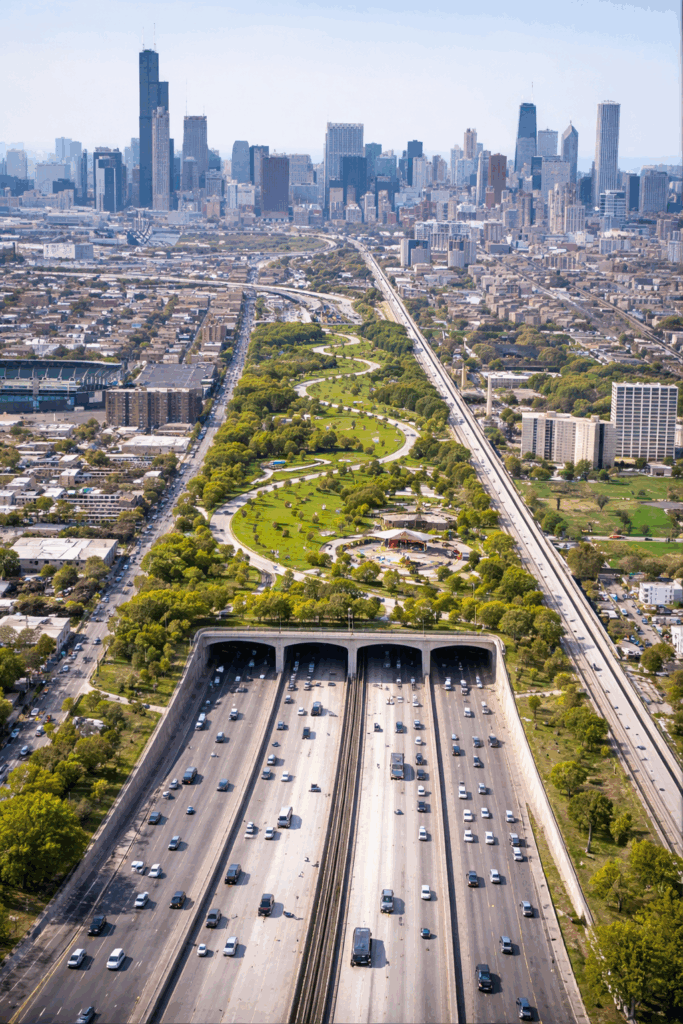
Chicago’s expressway system, once a symbol of progress and mobility, left a legacy of division and segregation. Highways like the Dan Ryan and Eisenhower Expressways carved through vibrant neighborhoods, severing social, economic, and ecological connections that had taken generations to build. This proposal envisions a bold step toward repairing that damage: a set of major highway caps that reconnect neighborhoods, restore green corridors and boulevards, and redefine how infrastructure serves communities.
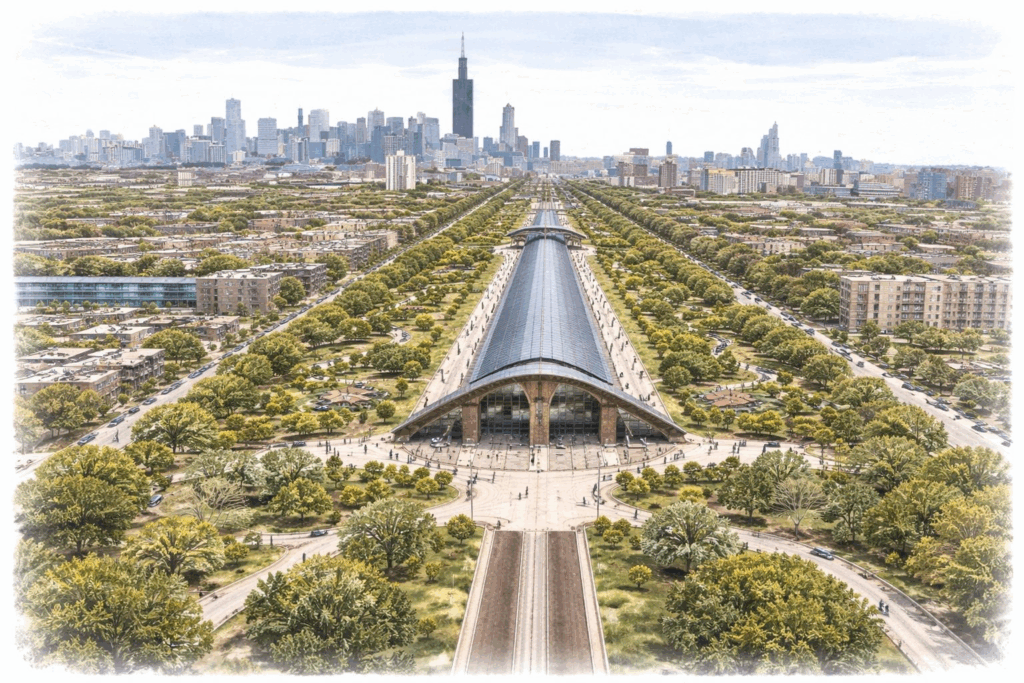
By creating large-scale caps over key segments of the Dan Ryan and Eisenhower Expressways, Chicago can physically and symbolically stitch back together neighborhoods on the South and West Sides. These caps would function as multi-use public spaces, parks, plazas, community hubs, and development, transforming spaces of separation into spaces of connection.
This idea matters for Chicago’s future because it reframes infrastructure as a tool for equity, climate resilience, and community revitalization. In addition to reconnecting neighborhoods, these caps can reduce flooding through green stormwater infrastructure, capture carbon emissions, mitigate extreme heat with expanded green space, and improve the transit rider experience. They also expand parkland, strengthen habitat connections, and create opportunities for equitable economic development, helping correct past harms while building a more inclusive and connected city by 2050.
Repairing the Harms of the Highway Era
The construction of Interstates 94 and 290 displaced more than 6,000 families and thousands of individuals in Chicago. These projects disproportionately impacted Black and immigrant communities, dismantling neighborhoods, eroding local economies, and reinforcing patterns of segregation that persist today.
Beyond displacement, these highways created long-term physical and psychological barriers. These corridors of fast-moving traffic limit pedestrian movement, isolate residents from destinations and contribute to environmental burdens like stormwater run-off, air and noise pollution, disproportionately affecting adjacent communities.
The city has started to explore smaller-scale caps, such as the proposal for a short cap along Independence Boulevard crossing I-290. However, this concept remains limited in scope relative to the scale of the original harm and need for present-day solutions, and without funding there is no current plan for implementation. This proposal calls for a more ambitious, systems-level approach, one that matches the scale of past disruption with equally transformative reinvestment.
A Transformative Vision for the Future to Knit Communities Back Together
By 2050, a network of highway caps across Chicago’s South and West Sides could reshape the city’s spatial and social fabric. Multiple wider caps would restore connectivity at a scale that would knit communities back together, improving access to jobs, schools, healthcare, and cultural destinations, while also buffering residents from highway noise and pollution.
These caps would unlock significant new public space, creating continuity between green corridors along existing boulevards and greenways into a more cohesive park system. This is a critical need for Chicago given Chicago does not rank in even the top ten largest U.S. cities in terms of the size and quality of parks, according to the Trust for Public Land’s ParkScore ranking. This expanded green network would support recreation, public health, and climate resilience through tree canopy growth and stormwater management, addressing Chicago’s shortage of park land, which is particularly acute in areas along these highways.
At the same time, caps would transform the transit rider experience along corridors like the Red Line South and Blue Line Forest Park Branch. CTA rail lines currently run within highway medians, and the open platforms expose riders to excessive noise, emissions, wind and extreme heat. By creating new land around stations, caps would enable transformed transit station areas with safer, more comfortable access to transit, while creating conditions for equitable transit-oriented development. These areas could accommodate mixed-use, community-focused development that prioritizes affordability and local businesses, while helping stabilize neighborhoods and signaling long-term investment in the South and West Sides as central to Chicago’s future.
Where and How the Idea Might Live in Chicago
This vision focuses on two initial corridors that address locations of greatest need and illustrate the concept’s potential:
The Dan Ryan Expressway near Garfield Boulevard: A cap spanning multiple blocks could reconnect Bronzeville and Washington Park, linking residential areas to parks, schools, and cultural assets. This location offers the opportunity to create a signature public space with views toward downtown, reinforcing its role as both a neighborhood and citywide destination.
The Eisenhower Expressway near Independence Boulevard: Building on prior proposals, an expanded cap here could reconnect neighborhoods in East and West Garfield Park while improving the conditions of existing transit. This area has experienced significant disinvestment but also has strong community networks and proximity to transit, making it well-positioned for reinvestment.
Over time, additional locations, and other corridors could be evaluated, prioritizing improving access to existing transit stations, creating a broader system of reconnected neighborhoods.
Now is the Time to Integrate Highway Caps into Reconstruction Proposals.
Coalitions of agencies and stakeholders are working to coordinate reconstruction of the Eisenhower expressway and the CTA Blue Line Forest branch since both are past their useful life. There is desire to fully re-envision such corridors, prioritizing a truly multimodal approach. Now is the perfect time to commit to incorporating a substantial highway cap into that project to ensure that it repairs the past harms sustained by adjacent communities and provides transformative benefits at a regional scale.
Implementing this vision will require alignment and collaboration from a range of transportation, environmental and economic development agencies to conduct planning and secure funding. A partnership was formed via intergovernmental agreement among Illinois DOT, Chicago Metropolitan Agency for Planning at the CTA in 2023, and coordination has already begun on writing collaborative grant applications. The CTA has secured grants to address flooding and operational issues that will set the stage for corridor reconstruction.
Previously, CTA published its Blue Line Forest Branch Vision Study report with sketch renderings of what could be possible with such treatments. Illinois DOT recently published its Blue Ribbon Commission Report to the Illinois General Assembly, which describes the importance of integrating sustainability into future transportation projects. The City of Chicago secured a federal grant for community planning along the corridor via the federal Reconnecting Communities program that will engage community-based organizations. Philanthropic organizations can support early-stage planning. Private sector developers will find new opportunities for transit-oriented development. Open space and park advocates will be able to create connected ecosystems and habitats. Labor organizations are eager to work on this large-scale effort. This highway reconstruction project is one of the highest priorities for a wide range of stakeholders.
Future Resources for Implementation
This idea must be integrated into the highway reconstruction project under development now so that it is fully considered along with the multimodal transportation elements. Our region can learn lessons from other regions that have already implemented similar strategies and build on those best practices. Since significant new land will be created that can support development, this approach should integrate value capture financing strategies, which have previously been used in this region and can be expanded. As the Federal transportation reauthorization is up for renewal later this year, leadership can advocate for elements of the federal program that could support such transformative projects to reduce harms of Federal highway infrastructure. The state will likely be pursuing a capital bill in the coming years to follow up on the 2019 Rebuild Illinois program and can incorporate elements of such projects into those efforts. It will also be important to ensure zoning and land use policies prioritize equitable, transit-oriented development on and around capped areas.
An Effective Solution for Communities Divided by Highways
This vision is ambitious but grounded in current momentum. Across the United States, cities are beginning to remediate the harm caused by highways to reconnect communities. Chicago itself has already taken initial steps, applying for funding for a small highway cap on Independence Boulevard. Under the Biden Administration, the Reconnecting Communities grant program encouraged and provided funding for projects of this type.
At the same time, there is growing urgency to modernize aging infrastructure and improve multimodal options. As the state and region plan for future capital investments, there is a unique window to rethink not just how infrastructure is repaired, but how it can be transformed to meet the moment.
Importantly, this proposal aligns with multiple priorities already shaping policy discussions: equity, climate resilience, public health, and economic development. By addressing all of these goals through a single, integrated strategy, highway caps offer a compelling return on investment.
With strong leadership, community partnership, and strategic use of available tools, Chicago can begin to repair the scars of past decisions, turning bar