
Agriflats
Horizon Lines Finalist
By Wheeler Kearns Architects | Lawrence Kearns, FAIA
Wheeler Kearns Architects is a collective practice of architects that has been dedicated to creating places that embody our clients’ purpose, energy, and vision for the last 39 years.
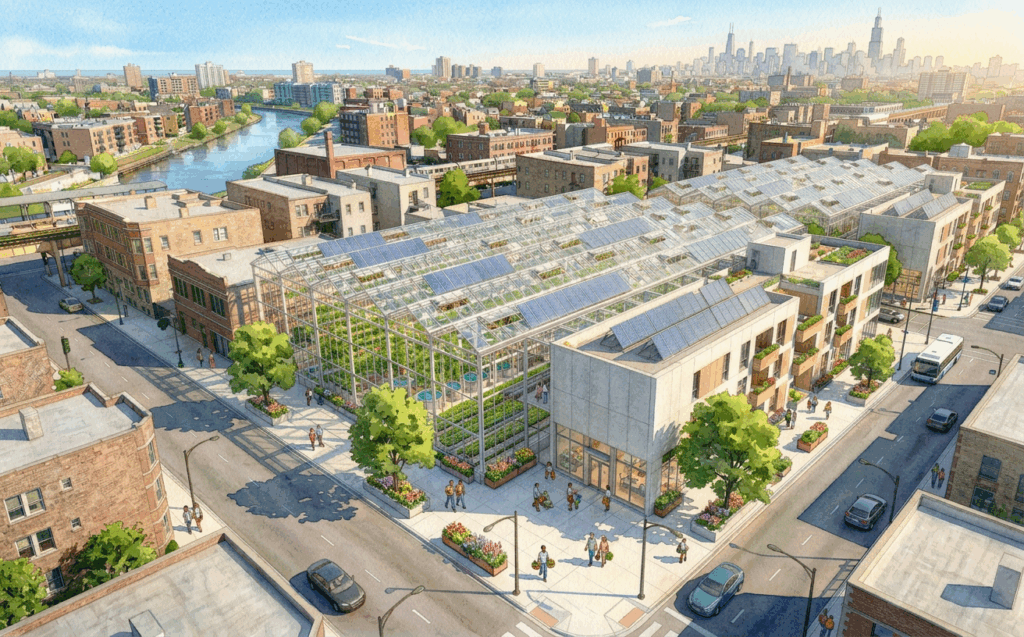
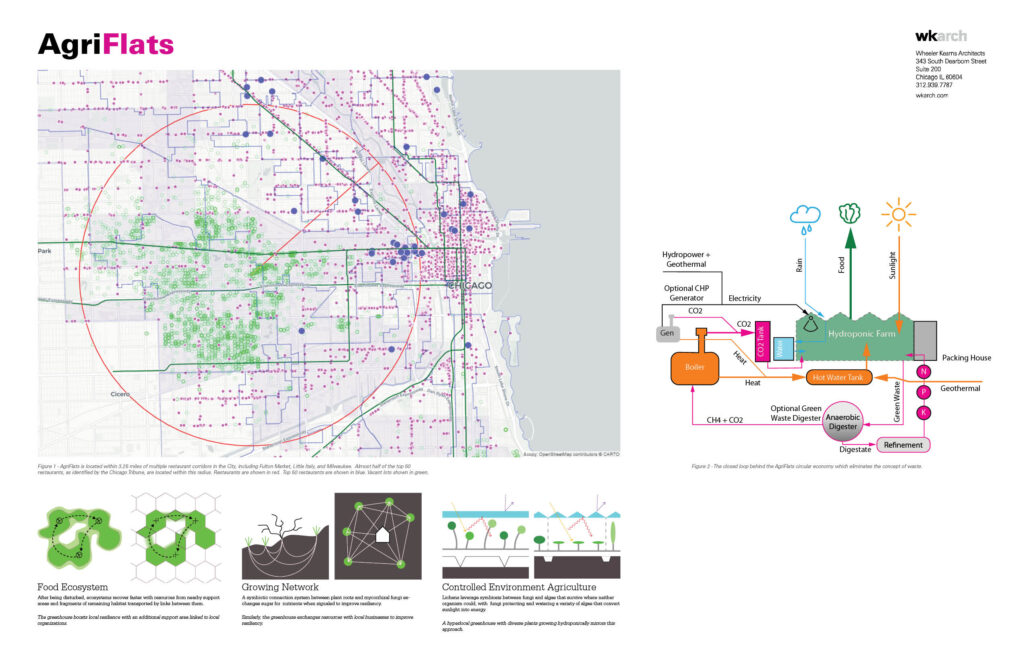
Within miles of the City’s top restaurant corridors, a new food production facility in a Chicago neighborhood can provide a puzzle piece to Chicago’s first bona fide Food District. Within a 20-acre footprint, food production can catalyze new processing, transportation, distribution, and preparation venues for the first time in our City’s modern era. Food production will interlock with community resources to create new synergies and provide jobs immune to AI disruption.
In its history, Chicago has derived great wealth from food. It served as the shipping hub for the Midwest’s agricultural bounty, an outpost for immigrant cuisines, and an inventor for confections and variations on ethnic foods. In this innovative culinary chapter, Chicago will reinvent how it feeds itself by sustainably growing healthy hyperlocal food.
Unlike the status quo, food will be 100% pesticide-free, grown year-round within a major US city, creating new entry-level jobs where workers earn a living wage, and using 90% less water than field-grown vegetables. Within a day, the harvested food will travel to the market.
Fostering food culture in Chicago will do more than feed people. It will connect citizens, without regard for socioeconomic status, gender, age, or ethnicity, with a great unifier – food. The District will build resiliency through better food choices offered by a coherent food system.
AgriFlats combines a business incubator with Dutch-style Controlled Environment Agriculture (CEA) to provide 13 aspiring growers with a one-acre greenhouse and an attached live-work unit, enabling them to launch new businesses while creating jobs in the community. Supported by a newly created Cooperative, AgriFlats provides community support, including meeting, learning, and housing spaces to benefit residents. Instead of the greenhouses just producing food, they will be economic generators, creating new year-round jobs.
AgriFlats will create 230 nonseasonal, permanent jobs in the community. Annually, AgriFlats will be responsible for 159 direct jobs, most of which can be filled by local residents trained by not-for-profits already operating in the City.
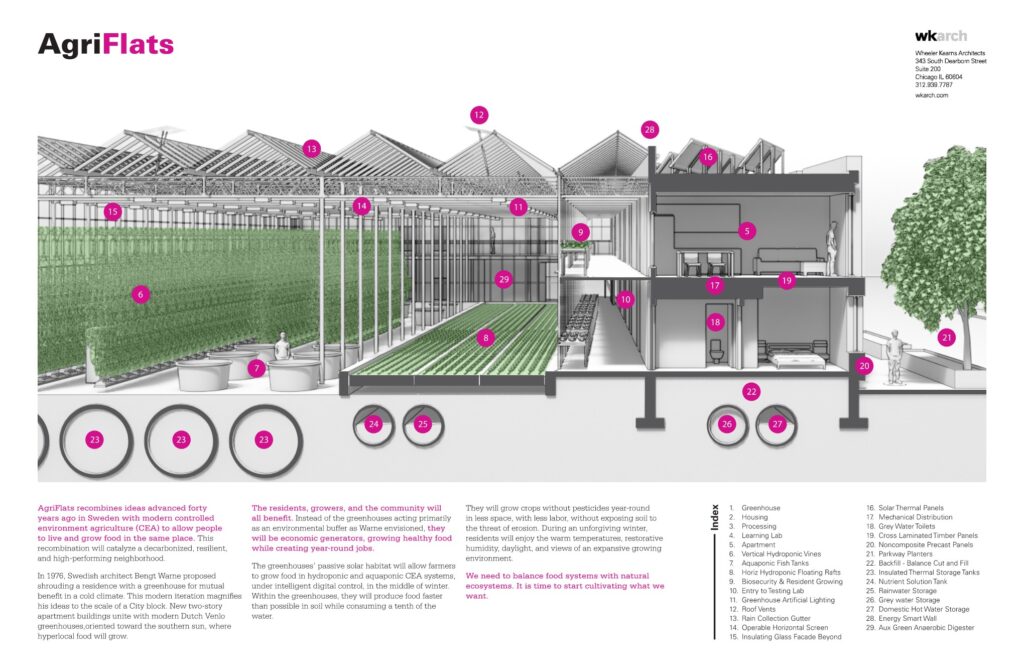
For AgriFlats farmers, the greenhouses’ passive-solar habitat will allow them to grow food in hydroponic CEA systems under intelligent digital control in the middle of winter. Within the greenhouses, they will grow food faster than possible in the soil while consuming a tenth of the water. They will grow crops year-round without pesticides in less space, with less labor, and without exposing soil to the threat of erosion, which has accelerated with climate change.
Chicagoans will be able to enjoy fruits and vegetables ripened on the vine year-round in their City, selected for taste rather than durability for transport. The COVID pandemic highlighted the fragility of the current food system’s long supply chains. Food grown locally will have a longer shelf life and a longer home life.
Instead of a permanent location for growers, AgriFlats intends to be an incubator and accelerator. Once growers achieve success at a modest scale within 5 to 7 years, they will scale their operations elsewhere to increase profitability and reach.
Decarbonization
The primary energy powering AgriFlats is renewable solar energy. The transparent skin of a greenhouse admits a broad range of solar energy, which is trapped inside, heating the interior during winter. During extreme cold, active energy harvested by solar thermal collectors mounted on the packing house, live-work, and residential rooftops will supplement the passive solar energy. These collectors will heat circulating water with the sun’s energy and pump it into underground storage tanks, insulated with vacuum-sealed insulation like a thermos bottle. .
Since Chicago’s climate demands three times as much energy annually to heat and cool its buildings, AgriFlats prioritizes low-grade thermal energy over high-grade photovoltaic energy. Solar thermal collectors will harvest much more of the sun’s energy, at up to 70 percent of the sun’s available energy compared with only 20 percent for photovoltaic panels.
Summertime cooling will still be necessary. To provide passive cooling, roof vents in the Dutch Venlo greenhouses will open, allowing hot air to escape. Circulating water, stored underground at a stable 55F temperature, will cool the incoming air. Likewise, the nutrient solution, which resides below grade, will help cool the greenhouse during the summer.
The residential units abutting the greenhouses will be heated and cooled with an active-slab radiant system that maximizes comfort while minimizing energy use. Combined with the hyper-insulated, thermally massive structure, residents’ energy needs will be met on-site. Energy recovery ventilators (ERVs) will introduce fresh air into the apartments, recycling the greenhouse’s heat and moisture.
Electricity can also be produced on-site by a Combined Heat and Power system (CHP) with gas produced by an anaerobic biomass digester. The digester can also produce natural gas for heating. The biomass will come from the growing operation itself and the waste from restaurants and community members connected with AgriFlats. Growers can purchase any additional electrical energy required from off-site renewable sources.
In addition to powering pumps, the facility will use electricity to illuminate the greenhouses during winter and the residences year-round. The apartment interiors will be illuminated solely with LED sources to conserve energy. During winter, spectrally selective LEDs will light the interior to extend the natural day to 14 hours. All waste heat emitted from these light fixtures will supplement greenhouse space heating. Greenhouse lighting will be shielded from any surrounding residences.
Achieving Balance
If a shortfall of stored heat occurs during winter, the anaerobic digester’s natural gas reserves will provide the energy. If additional heat is required, natural gas obtained from the grid will heat the space.
Unlike most projects, though, the CO2 liberated by fossil fuel combustion will be captured for enriching the greenhouse, where rapidly growing plants will sequester it. In addition to 13 nutrients and water, plants build themselves with the atmospheric elements of carbon, hydrogen, and oxygen.
Green Mobility
AgriFlats growers will be able to transport food quickly and economically. Commercial electric vehicles will deliver food harvested just in time to nearby produce distributors, restaurants, and local farmers’ markets. Non-food exports, such as liquid fertilizer, can be transported from the greenhouses to the Park District or local urban soil farms using cooperatively operated electric vehicles.
Products used in the greenhouses for pollination, integrated pest management, nutrients, and germination will be purchased and transported cooperatively. Experts and consultants supporting farmers raising different crops can make a single trip to the District, reducing time, expense, and carbon footprint.
Resiliency
Since hydroponic growing uses a tenth of the water required for soil-grown crops, they are exponentially more drought-resistant. The underground reservoirs for process water used in AgriFlats will be sized for 100-year drought conditions, securing the District’s food supply.
AgriFlats will also collect rain for non-potable (grey-water) uses in the live-work units and residences, such as toilet flushing and laundry. These systems, which will divert twice their volume from City sewers, will be isolated to maintain health by preventing cross-contamination. Low-flow fixtures will be installed throughout the residences, further conserving domestic water use. During the cooling season, valves will divert the condensate from cooling systems for grey-water use.
Housing & Live Work Units
AgriFlats recombines ideas advanced forty years ago in Sweden with modern controlled environment agriculture (CEA) to allow people to live and grow food in the same place. This recombination will catalyze a decarbonized, resilient, and high-performing neighborhood.
New two-story apartment buildings and live-work units for the growers will unite with modern Dutch Venlo greenhouses.
AgriFlats growers and residents will occupy homes partially shrouded from the harsh winter cold, winds, and year-round destructive ultraviolet radiation. Amid an unforgiving winter, they will enjoy the warm temperatures, restorative humidity, daylight, and views of an expansive growing environment. Beyond the pleasant atmosphere, the adjacency will save energy costs for residents and farmers. Instead of growing in a freestanding greenhouse exposed on all sides to winter winds, farmers will be sheltered by the walls of their live-work units or homes, which can store thermal energy, saving heating costs.
Cooperative Biodiversity
Even in CEA greenhouses in the exurbs of Chicago, which can be up to 30 acres in size, crops are usually grown in monocultures to prevent disease and pest infestations. In contrast, a congregation of smaller greenhouses like AgriFlats will encourage urban growers to grow a diverse range of crops cooperatively. Although lacking the economies of scale possible in the exurbs, AgriFlats will compensate for the uncommon availability and variety of fresh food.
Data gathered from growing operations will also be shared cooperatively. Growers could participate in an online business-to-business (B2B) exchange, creating a hyperlocal marketplace that anticipates and values non-commodity food. Buyers, such as processors or restaurants, could access real-time data on the maturity, nature, and variety of food being grown in clusters of greenhouse farms to plan new products and menus.
Purposeful Design
By establishing Chicago’s first Food District, food producers will be able to share risk and resources. At the same time, residents will enjoy a wide variety of healthy, local, fresh food.