
Business Leadership
Chicago’s Advantage
10.30.2025
Chicago’s life sciences and healthcare sectors are powering one of the fastest-growing segments of our regional economy — now employing more than 90,000 people, generating $47.8 billion in annual output, and ranking fifth nationallyamong metro areas for industry strength.
With seven medical schools, over 2,300 life sciences businesses, and the Illinois Medical District—one of the largest urban medical districts in the country—Chicago stands at the forefront of global health innovation. For more information, we invite you to read Chicagoland By The Numbers, an annual economic review produced by The WBC Research Center.
Affordable lab space (half the cost of New York, nearly 40% lower than Boston), a thriving network of 100+ incubators and accelerators like Matter and 1871 , and deep venture capital support through firms like Portal Innovations and ARCH Venture Partners make this region a magnet for healthcare and biotech investment.
At the same time, Chicago’s academic medical centers (AMCs) are redefining what it means to anchor community well-being in measurable outcomes—connecting health equity, workforce opportunity, and economic vitality. Across the region, AMCs are investing in partnerships and models that address the root causes of health disparities and build stronger, more resilient neighborhoods.
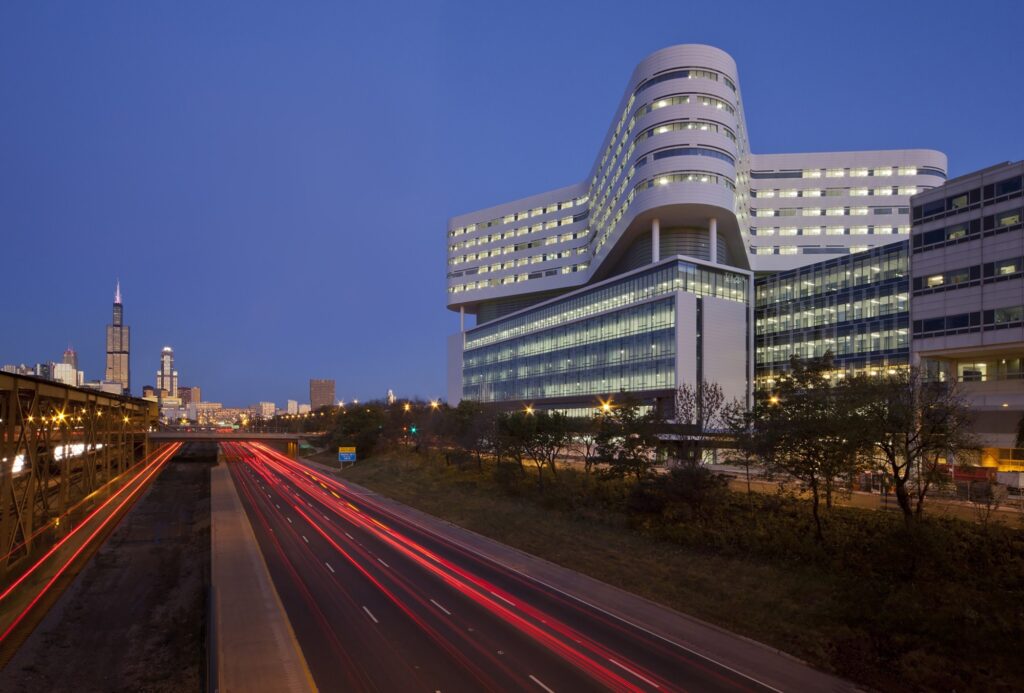
This week, we invited Dr. Garth N. Walker, MD, MPH, Chief Medical Officer at Rush Health, to share how Rush’s anchor mission is helping close the life-expectancy gap across Chicago’s neighborhoods—and how academic medical centers collectively are helping redefine what’s possible for cities worldwide.
Dr. Garth N. Walker, MD, MPH, Chief Medical Officer, Rush Health

Chicago is a city that feels both deeply local and undeniably global. Within just a few miles, one can experience vastly different realities shaped by history, opportunity, and community. Yet, what binds Chicago together is its unmatched civic spirit — its foundations, Fortune 500 companies, and community leaders working in concert to tackle bold missions.
It was this ethos that drew me to Rush University Medical Center, an academic medical center that declared its goal as a system was to help close the life expectancy gaps seen on the West Side of Chicago and the Gold Coast. In 2020, I served as deputy director at the Illinois Department of Public Health, helping protect vulnerable communities during an unprecedented crisis. Later, as a White House Fellow, I addressed pressing issues like gun violence, mental health, and physician burnout. A consistent lesson emerged: academic medical centers with bold public health missions are uniquely positioned to address the most pressing challenges of our time.
Health systems that integrate patient care with medical education and research are far more than health care providers, but rather are anchors in their communities. Academic medical centers (AMCs) often sit at the crossroads of privilege and poverty. Their roles span from world-class specialty care to safety-net services for the most vulnerable and inherently delivering world-class research and innovative partnerships meant to improve the health of our communities. They are also the anchors of their communities and are among the largest employers and spenders in their neighborhoods. These large and diverse responsibilities empower them to innovate, align care with community needs, and anchor health equity in measurable outcomes. From housing and economic stability to chronic disease management, AMCs can drive change across the very benchmarks that determine life expectancy in our city.
Imagine the impact if every AMC set meaningful goals tied to community health, economic stability, and mortality reduction — goals supported by a reimbursement environment that accounts for both sickness and social context. Consider the combined power in the Chicago area alone of Rush and our fellow AMCs at Northwestern, University of Chicago, University of Illinois, and Loyola, which together bring in more than $9.7 billion in net patient revenue and employ more than 50,000 people.
When Rush set its sights on raising the average life expectancy of the West Side, which can be as much as 14 years shorter than residents of downtown, we took focused and impactful action to improve the help of our community. Rush fully engaged not only our staff and students, but also our board of trustees in our mission. This led to a commitment for strategic and continued financial investment in our mission and communities.
The results are powerful:
These economic investments are directly tied to health outcomes, as stable employment and income are key social determinants of health.
Together, AMCs can do so much more to leverage our anchor missions to address the social determinants of health through research, community benefit, innovation, and investment.
I have seen the stakes firsthand: as a physician at the bedside of families facing avoidable crises, and as an executive witnessing the consequences when patients and providers are not consistently placed at the center of mission. To move forward, AMCs must continue to integrate public health and economic principles into their operations while partnering with business and community leaders as well as public and private payers for meaningful long-term partnerships that center on patients and physicians. When they do, they not only save lives—they help redefine what is possible for a city like Chicago.
As we close this week’s edition of The WBC Business Pulse, powered by LinkedIn, our sincere thanks to Dr. Garth N. Walker, MD, MPH, and the Rush University Medical Center, for sharing a model that proves healthcare innovation is as much about compassion and community as it is about science. Their “anchor mission” is a reminder that the future of business in Chicago is built not only in boardrooms but also in hospitals, classrooms, and neighborhoods.
If you’re working on an economic development initiative, partnership, or idea that’s shaping Chicagoland’s economy — we’d love to feature you in a future edition of The WBC Business Pulse. Drop us a DM. Together, we’re building a city and region where business growth and community health move forward, side by side.

Business & Growth
Business Leadership
NEWS
WBC Initiatives
10.07.2025
In-person convenings matter. Last week, a Chicago-led delegation traveled to Beijing, Hangzhou, and Hong Kong, engaging directly with business and government leaders at a time of both challenge and op

Business Leadership
NEWS
07.31.2025
This week in The WBC Business Pulse powered by LinkedIn, we’re spotlighting a vital voice in our ecosystem: Michael Edwards, President & CEO of the Chicago Loop Alliance. Representing Chicago&he

Business Leadership
WBC Events & Recognition
07.23.2025
Meet Myrna Farmer, Executive Director of Board Relations at World Business Chicago, whose remarkable journey from humble beginnings to diplomatic heights exemplifies the essence of Women’s Histo

Business Leadership
WBC Events & Recognition
07.23.2025
Chicago, IL – The Chicago Venture Summit Future-of-Food, the flagship event of the region’s venture and startup community, which has garnered a national reputation as one of the premier