
1. Chicago Signal
Team Name: Chicago Signal
Key Contributors:
Alex Kelleher – Founder & CEO, Quantum Rise; Concept Lead
Roman Kelleher – Co-creator; Design Inspiration & Origami Concept
Quantum Rise Team – AI, systems design, and human–machine interaction expertise (supporting contributors)
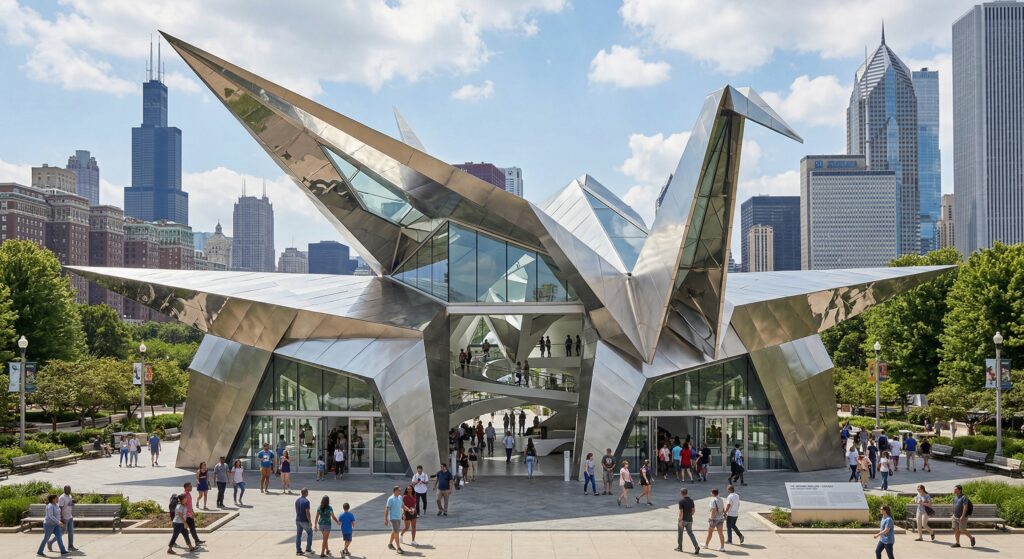
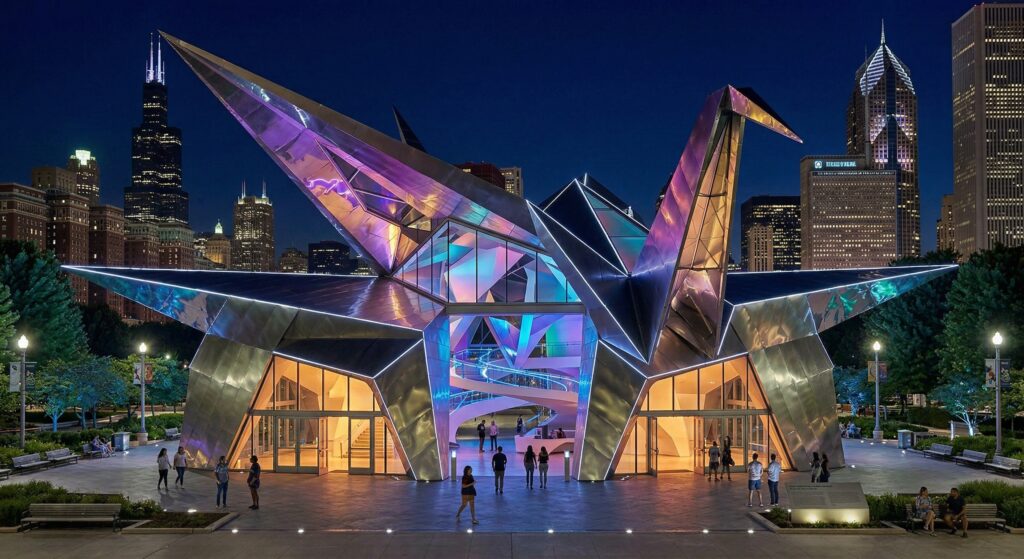
Chicago Signal is a proposal for a citywide civic infrastructure system designed to make Chicago’s long-term future more visible, participatory, and collectively shaped. At its center is a sculptural landmark inspired by an origami crane — a steel-and-light structure intended to join the ranks of Chicago’s iconic public spaces — that would serve as a “civic observatory” where residents and visitors can use AI-assisted tools to explore how decisions around housing, climate, mobility, and economic growth might shape the city through 2050.
But the landmark is only one piece of a three-part system. Neighborhood signal nodes — smaller installations embedded in libraries, parks, schools, and transit hubs across the city — would extend the concept into communities beyond downtown, allowing residents to weigh in on local and citywide priorities from familiar, trusted spaces. A digital platform rounds out the network, enabling remote participation from Chicagoans across the diaspora and feeding real-time data back into the system’s evolving representation of the city.
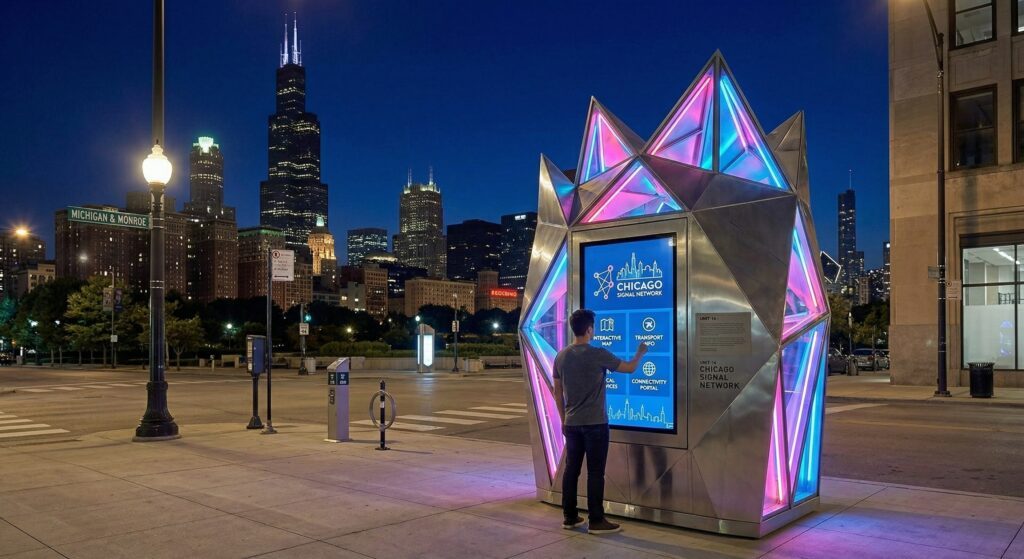
The proposal takes direct aim at a persistent gap in civic life: consequential decisions about the city’s future are often made in institutional silos, with limited public visibility or input. Chicago Signal reimagines that process as an ongoing, distributed conversation rather than a series of closed-door determinations.
Developed by Alex Kelleher and his son Roman — one who chose Chicago as his home, the other growing up into its future — the project frames urban planning as something built not through singular decisions, but through the accumulation of many small, deliberate choices made together over time.
2. The Teal Project – Chicago Event Park
Team:
Tracy Brown – Southeast Side
William Aguilar – Southwest Side
Matthew Meade – Northwest Side
Steve Niketopoulos – Northeast Side
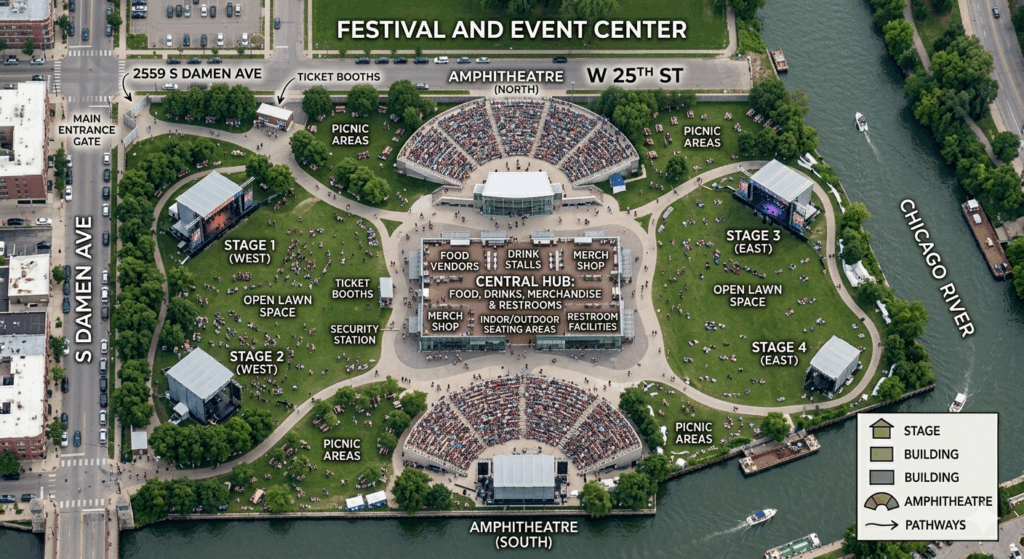
Chicago Event Park proposes transforming 50 acres of underutilized industrial land along Chicago’s southwest waterfront into a permanent, large-scale outdoor event venue — purpose-built to relieve the mounting pressure that major festivals and concerts place on Grant Park and the downtown core.
The proposal starts from a concrete problem: Chicago’s reliance on a hyper-concentrated, downtown-centric event model is straining the city’s infrastructure. Lollapalooza, NASCAR, and similar activations flood a square mile already burdened by daily commuter and tourism traffic, pushing expressway delays up by as much as 300% on peak weekends and causing park closures during lengthy post-event restoration periods. Economic benefits, meanwhile, remain largely trapped in the Loop.
The Chicago Event Park (CEP) offers a structural alternative. Rather than continuing the costly cycle of temporary pop-up infrastructure, the proposal envisions a permanent, high-tech campus with integrated stages, fiber-optic connectivity, and clean power — eliminating diesel generators and compressing multi-week setup timelines to hours. The site, centered near Bridgeport and McKinley Park, would open previously inaccessible riverfront land to public recreational use year-round.
Equity is central to the concept. A vendor lottery and rotation system would reserve kiosk space for minority- and woman-owned businesses from all 77 neighborhoods, creating a direct pipeline into Chicago’s $2.8 billion live entertainment industry. Permanent jobs in operations, AV logistics, and hospitality would be anchored on the Southwest Side.
A “Second Coast” transit strategy — expanding water taxi service along the Chicago River alongside CTA Pink and Orange Line connections — would move attendees from the Loop without simply relocating congestion to a new neighborhood.
3. The Pause: Public Toilets for Chicago
Team Name: The Pause
Key Contributors:
Cultural Stadium (Lead Organization): Lou Raizin
Perkins&Will: Bryan Schabel (Principal), Margaret Cavenagh (Managing Principal), Kristin Rosebrough (Principal), Hsu Myat Aung (Design Team), Rafi Alam (Design Team), David Rader (Competition Lead), Neil Reindel (Competition Organizer)
Converge Architecture: Annabell Ren (Design Team), Lynsey Sorrell (Principal), Steven Karvelius (Managing Principal)
DAAM: Alex Shelly (Principal), Elyse Agnello (Principal)
Civic Projects: Monica Chadha (Founder and Principal Architect), Rolf Temesvari (Design Team), David Hoff (Design Team)
The Pause is a design initiative reimagining what public restrooms in Chicago could be — reframing a chronic urban infrastructure gap as an opportunity for architectural ambition, civic equity, and genuine hospitality.
The project originated as an internal design competition organized by Cultural Stadium’s Team Culture, inspired by Tokyo’s celebrated public toilet program. The premise was straightforward but pointed: public restrooms in Chicago’s Loop are scarce, inconsistent, and often dependent on the goodwill of private businesses or the variable hours of parks and transit hubs. The competition challenged four teams to reimagine that reality along high-visibility corridors — the Lakefront Trail and the Riverwalk — producing facilities that are safe, dignified, and architecturally worthy of the city.
Following a two-week design sprint, teams presented to an invited panel of reviewers. The resulting conversation surfaced recurring themes: delight, accessibility, safety, sustainability, maintainability, and the potential for these structures to function as genuine landmarks rather than afterthoughts.
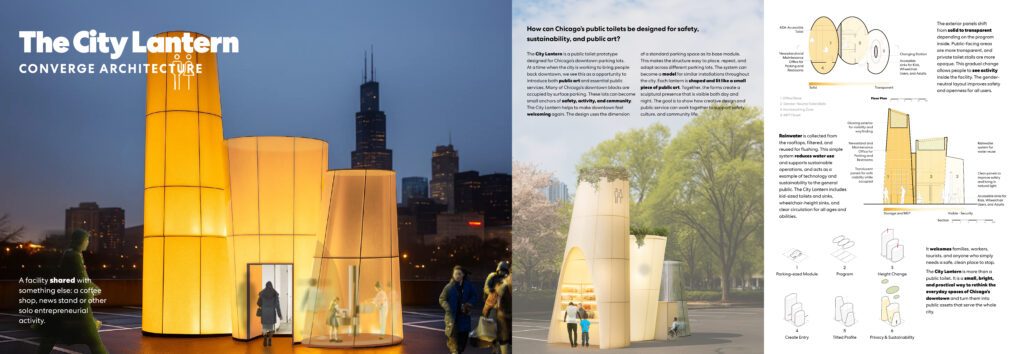
Four distinct concepts emerged. The City Lantern pairs restroom facilities with small-scale commercial activity — a coffee kiosk, newsstand, or solo entrepreneurial venture — animating the space and extending its hours of use.
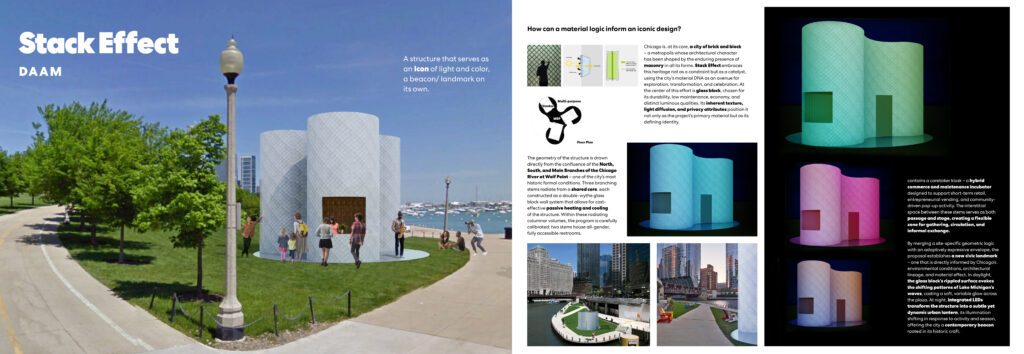
Stack Effect proposes a freestanding structure designed as a beacon of light and color, prioritizing iconicity.
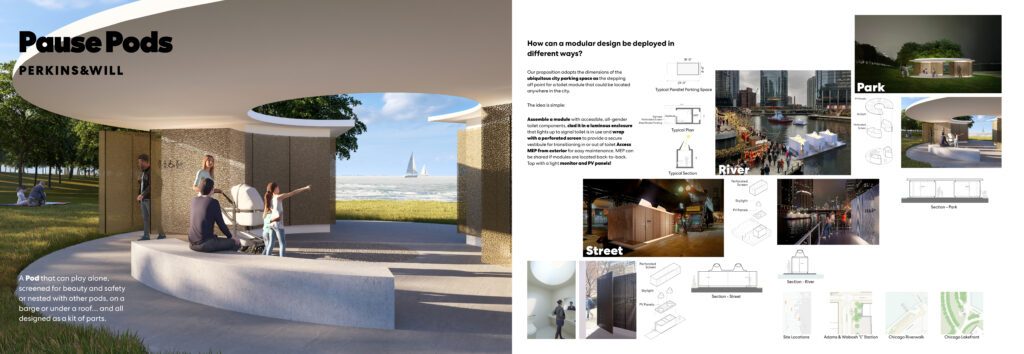
Pause Pods offers a modular, kit-of-parts approach that can be deployed individually or clustered, on a barge or under a roof, adaptable to varied site conditions.
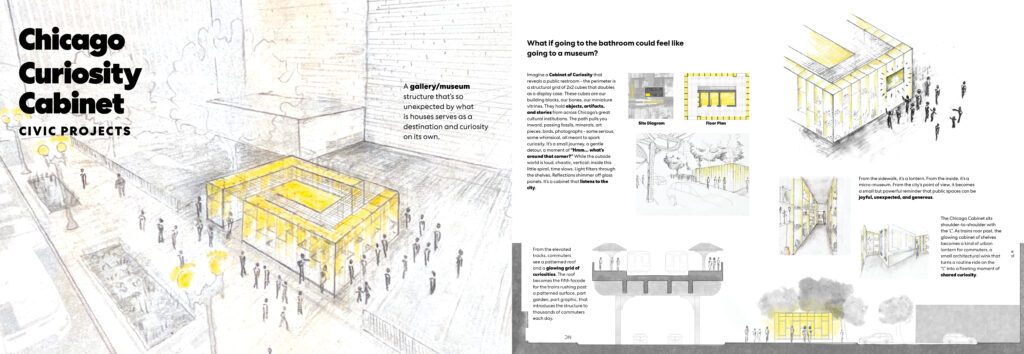
Chicago Curiosity Cabinet takes the boldest conceptual swing — a gallery-like structure so unexpected in its content that the restroom itself becomes a destination.
Taken together, the proposals make a case that public infrastructure, even at its most utilitarian, can set a standard for what a world-class city owes its residents and visitors.
4. The Cultural Zero Point (0,0,0)
Lead Applicant: SangYoun Han (Chicago-based Architectural Designer)
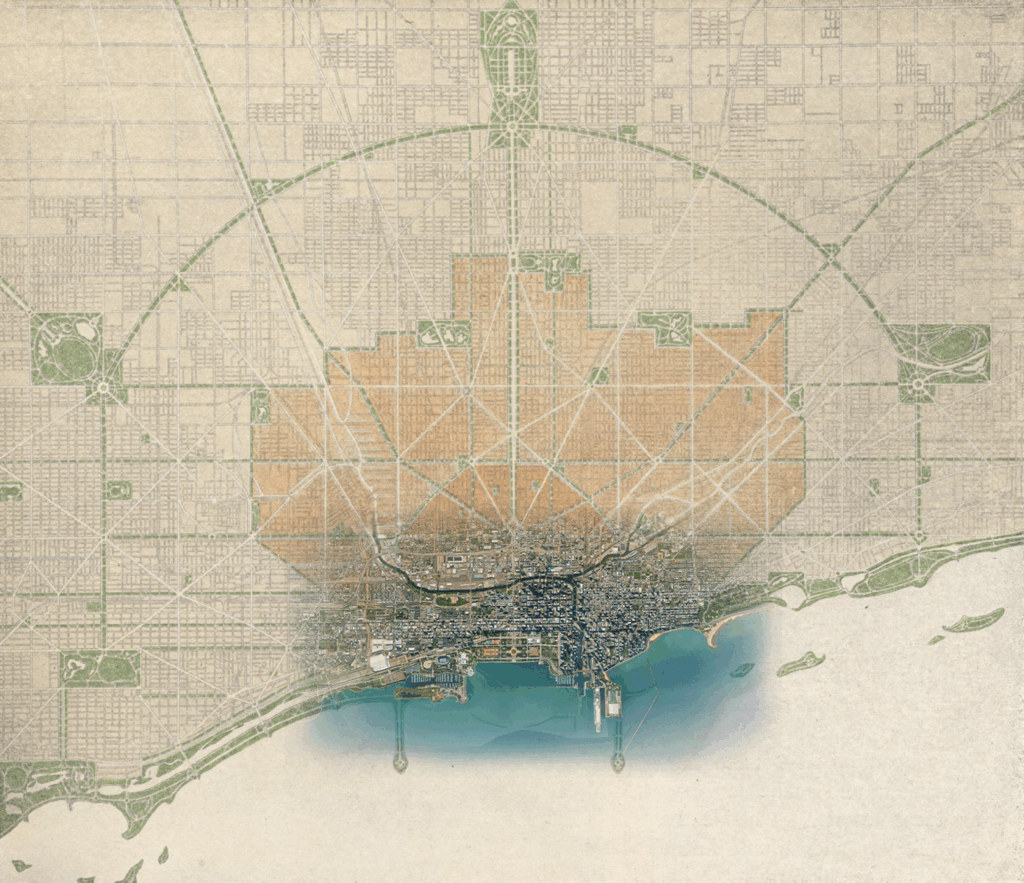
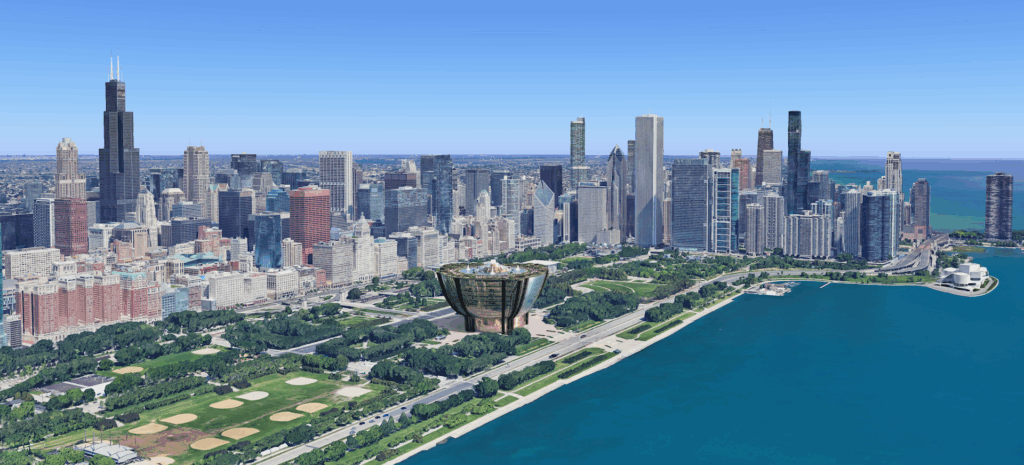
Cultural Zero Point (0,0,0) proposes a bold architectural and civic intervention at the heart of Grant Park: a 20-story vertical cultural hub rising directly above Buckingham Fountain, fusing Daniel Burnham’s historic horizontal vision for Chicago with the vertical ambition that has defined the city’s skyline ever since.
The proposal begins from a diagnosis. Despite its world-renowned architecture, lakefront, and constellation of cultural institutions, Chicago lacks a unified focal point — a single origin from which the city’s identity reads as coherent rather than fragmented. Millennium Park, the Museum Campus, Navy Pier, and the Riverwalk exist as isolated assets rather than a connected whole. The Cultural Zero Point would serve as the missing anchor, a “civic epicenter” from which Chicago’s scattered cultural geography finally coheres.
The centerpiece is the Floating Gardens of Buckingham — Buckingham Fountain elevated 20 stories into the air, its ground-level footprint preserved as open pedestrian plaza. At that strategic altitude, visitors encounter what the proposal calls a “panoramic layered skyline”: the full sweep from River North to the South Loop, Lake Michigan, and the Museum Campus simultaneously visible in a single view. Chicagoans with a city ID could access this civic balcony freely, positioning it as a public amenity rather than a commercial attraction.
The proposal extends outward from this vertical origin. A new Chicago Riverside Opera House at Chicago Harbor would create geographic symmetry across the lakefront, counterbalancing Navy Pier and evoking comparisons to Hamburg’s Elbphilharmonie. A unified water taxi network would stitch the full cultural corridor together — from the Gold Coast through Millennium Park, the Zero Point, the Museum Campus, and down to McCormick Place — while a CityPASS system would rationalize the tourist experience around a single hub.
Programmatically, the tower is designed for self-sufficiency: free exhibition and incubator space at lower levels, an experiential Chicago history museum in the middle, and revenue-generating restaurants and observation decks at the top funding the public programs below.
5. The Vortex
Lead Chicago-Based Organization: Human Architecture
Team Members: Jason Pieper — Architect, Research Lead, and Concept Designer
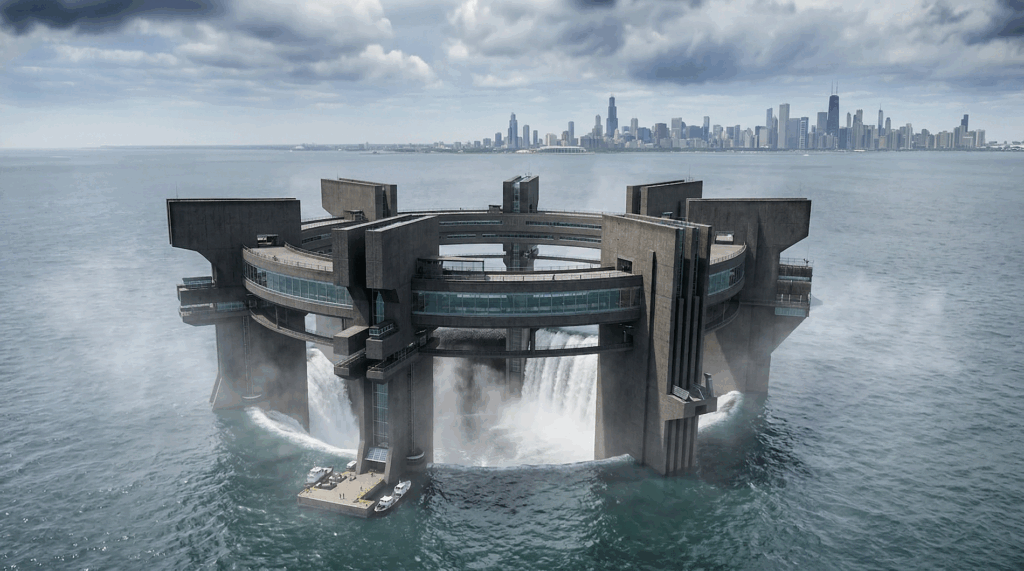
The Chicago Vortex proposes transforming Lake Michigan into an active energy system — a monumental circular hydroelectric generator anchored to the lakebed that converts the gravitational potential of the lake’s own water into continuous, renewable electricity for the city.
The concept is as visually striking as it is infrastructurally ambitious. From above, the structure appears not as a tower or platform but as a vast circular void in the lake’s surface — nearly half a mile across — where water folds inward and descends hundreds of feet through turbines embedded in the structure’s walls. Electricity generated by that controlled descent travels back to the city via underwater cables, while pumps redistribute the water into the surrounding lake, maintaining equilibrium. The lake’s surface and ecology, the proposal argues, remain largely intact.
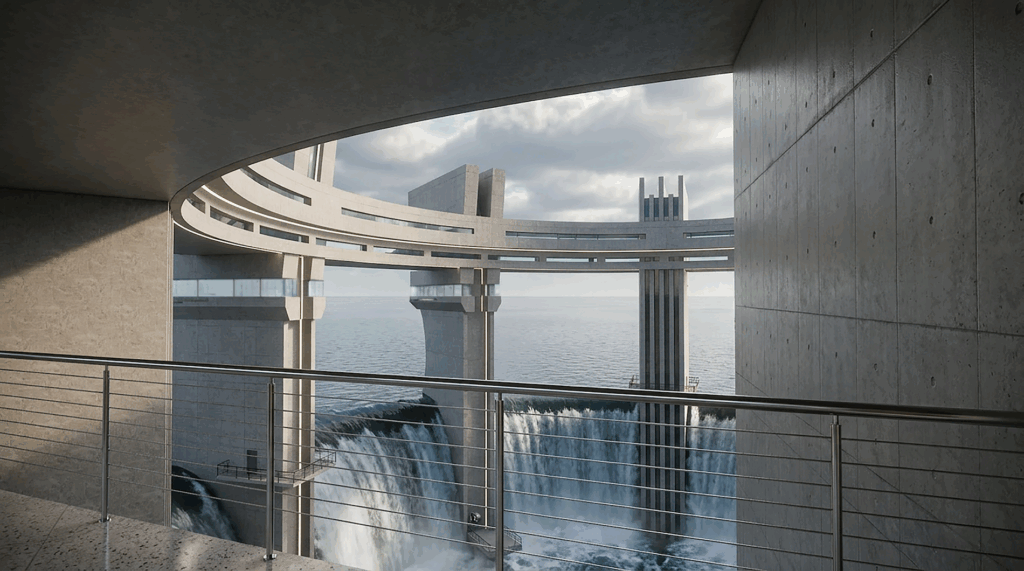
The proposal frames this as a direct response to a looming energy challenge. As Chicago electrifies heating systems and transportation through mid-century, demand will outpace what variable sources like wind and solar can reliably provide. Hydroelectric power offers the continuous baseline generation that a resilient grid requires — but Chicago lacks the rivers that conventional dams depend on. The Vortex reframes what the city does have: one of the largest freshwater lakes on earth, with immense untapped vertical energy potential between its surface and its depths.
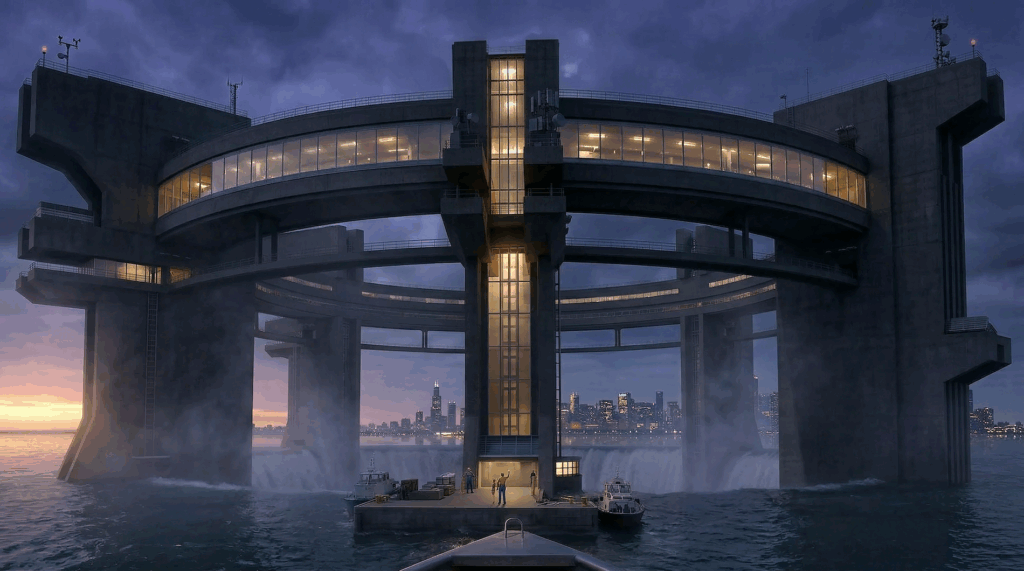
The project situates itself squarely within Chicago’s tradition of audacious civic engineering — the reversal of the Chicago River, the invention of the skyscraper — while inverting the city’s characteristic vertical ambition downward rather than up. Implementation would require phased feasibility studies, collaboration across public agencies and research institutions, and a financing mix of federal clean-energy funding, municipal green bonds, and public-private partnership.
6. Connections – Reimagining LaSalle Street for Chicago’s Next Chapter
Lead Chicago-Based Organization: Jahn/ (Chicago, IL)
Key Contributors + Roles:
Philip Castillo, FAIA – Managing Director and Design Lead
Stephanie Jolipa – Communications Strategy and Narrative Refinement
Graham Bowman, AIA – Project Architect with a focus on Urban Systems and Implementation
Geliang Zhu – Design and Visualization

Connections proposes transforming LaSalle Street — once the financial backbone of the Midwest — from a vehicle-dominated corridor into a pedestrian-first civic spine stretching from the Chicago River to Jackson Boulevard, reimagining one of the Loop’s most storied streets for the way Chicago actually lives and works today.
The proposal is grounded in an honest reckoning with LaSalle Street’s current condition. Remote and hybrid work have hollowed out its office population, ground-floor retail has struggled, and buildings designed for a different era sit underutilized. But the proposal frames this not as decline to reverse, but as an opening to redefine. Office-to-residential conversions are already bringing new residents into the Loop, and Google’s incoming Midwest headquarters at the Thompson Center will add thousands of daily workers to the corridor. The raw material for a neighborhood is arriving — the street just needs to meet it.

Three interventions form the core of the concept. First, vehicular traffic along LaSalle would be removed in favor of landscaped pedestrian space with dedicated bike lanes, flexible gathering areas, outdoor dining, and seasonal programming — giving new Loop residents an outdoor space they can claim as their own neighborhood. Second, mobility is redistributed rather than eliminated, with drop-off zones at cross streets and traffic shifted to adjacent north-south corridors like Clark and Wells. Third, a pedestrian bridge at Wacker Drive would physically reconnect LaSalle to the Riverwalk, creating a landmark northern gateway and extending the street into Chicago’s broader waterfront network.

Implementation is deliberately incremental — pilot closures and temporary programming in years one through three, permanent streetscape improvements through year seven, and full build-out including the bridge by year ten — reducing risk while building public momentum and stakeholder buy-in along the way.
7. The Blooming Barrier
Team Name: The Bio-Grid Collective
Lead Chicago-Based Organization: Clock Tower Innovations (based at mHUB Chicago)
Key Contributors:
Clocktower Innovations (Lead): Project Strategy, Vision Lead, and Urban Integration.
mHUB Chicago: Hardware Innovations & Prototyping: overseeing the physical design and manufacturing scalability.
University of Michigan: Technical Research & IP Licensing; providing patented technologies for aquatic stability and extensive experience in Great Lakes floating structures.
Urban Rivers: Operational Lead & River Integration; leveraging their successful experience with Chicago’s “Wild Mile” to manage local deployment and habitat maintenance.
Cleveland Water Alliance: Validation and Environmental Impact; facilitating LEPA (Leading Environmental Performance Assessment) testing and cross-lake data validation.
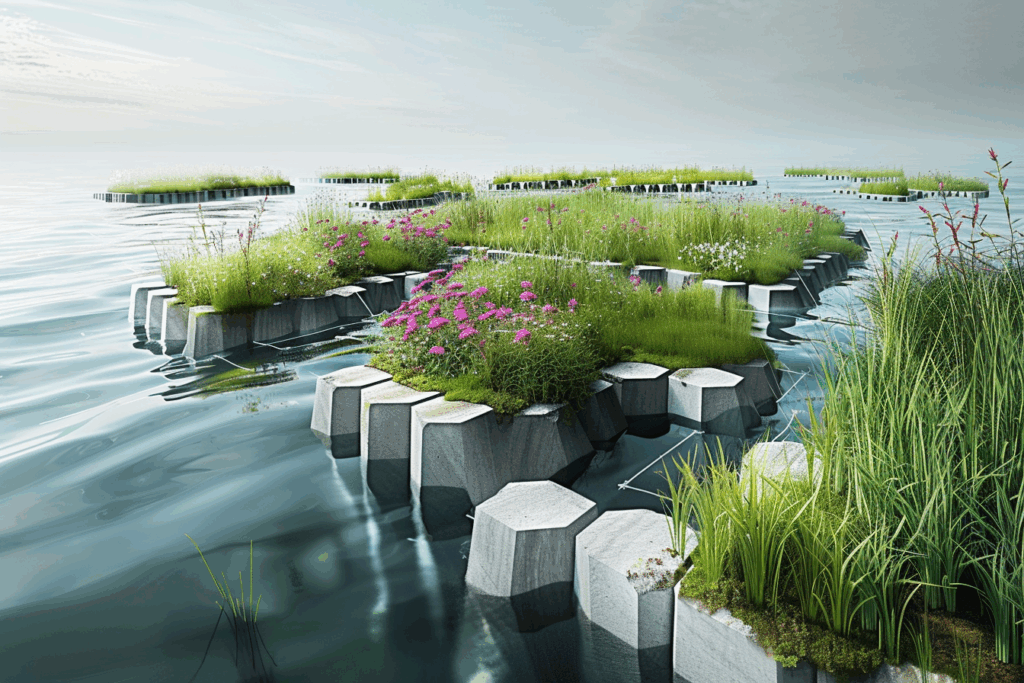
The Bio-Grid reframes Chicago’s relationship with its own waterfront — not as a fortress to be defended against Lake Michigan, but as a living system to be restored. The proposal replaces the city’s eroding concrete shoreline infrastructure with a modular, floating archipelago of hexagonal wetland gardens, drawing on the ecology of pre-industrial Chicago to solve a 21st-century climate crisis.
The urgency is real. Chicago’s beaches are disappearing at up to 100 feet per year in some areas, storm surge is threatening Lake Shore Drive, and South Side neighborhoods like South Shore face repeated catastrophic flooding. The city’s current responses — sandbags, Jersey barriers, repeated sand replenishment — are expensive stopgaps against a worsening problem. The Bio-Grid proposes a structural alternative: soft infrastructure that works with water rather than against it.
Each hexagonal module is a buoyant concrete platform densely planted with native Illinois wetland flora. Rather than deflecting wave energy like a rigid wall, the floating grid absorbs and dissipates it. Below the surface, deep root systems filter pollutants and heavy metals from the water in real time, while the structure itself creates underwater habitat for fish and above-water rest stops for migratory birds along the Mississippi Flyway.
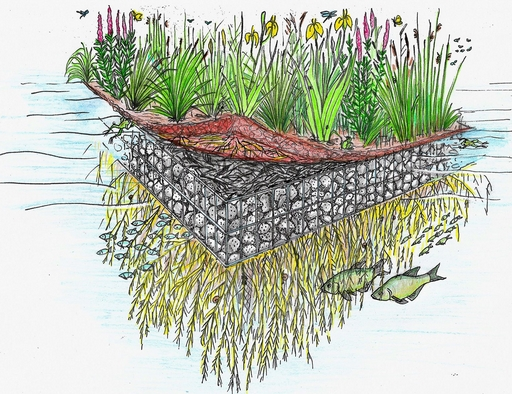
Three priority deployment zones anchor the vision: a protective offshore ring along the South Shore lakefront, green corridor installations along the North Branch Canal, and reclaimed industrial shipping slips on the Southwest Side transformed into neighborhood lagoons.
A ten-year implementation roadmap moves the concept from a 50-module pilot in the North Branch Canal through lakefront-scale deployment, culminating in a local Bio-Fabrication manufacturing facility in the Calumet corridor — turning the infrastructure itself into a source of neighborhood employment. By 2050, the proposal envisions Chicago’s horizon not as a hard gray edge, but as a soft, blooming threshold between city and lake.
8. The Floating Prarie
Lead Chicago-Based Organization: IDEO
Lead Applicant: Max Lackner, Senior Visual Interaction Design Lead, IDEO
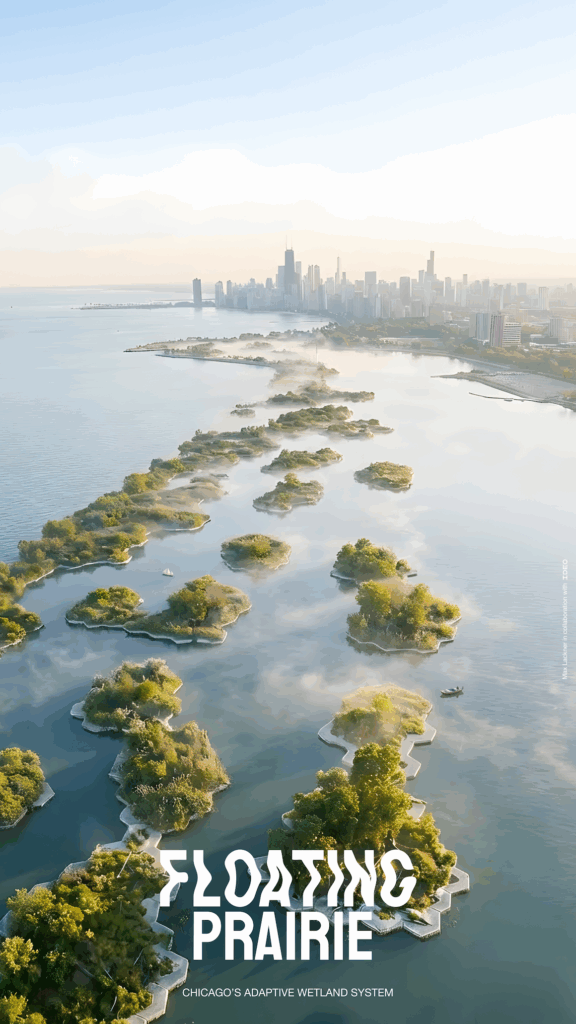
Floating Prairie proposes a network of modular, buoyant wetland islands extending into Lake Michigan along Chicago’s shoreline — living infrastructure that restores the ecological logic of the pre-industrial Chicago marsh to address the city’s accelerating climate vulnerabilities.
The proposal begins from a clear-eyed assessment of where conventional engineering is falling short. Flooding along the lakefront is becoming more frequent, shorelines are eroding, and biodiversity is in measurable decline. The same logic of control and permanence that built Chicago — mastering the grid, reversing the river, armoring the coast — is increasingly ill-suited to a problem that is dynamic and unpredictable. Floating Prairie’s answer is to reconstruct what preceded that engineering tradition: a soft, absorptive edge that yields to pressure rather than resisting it.
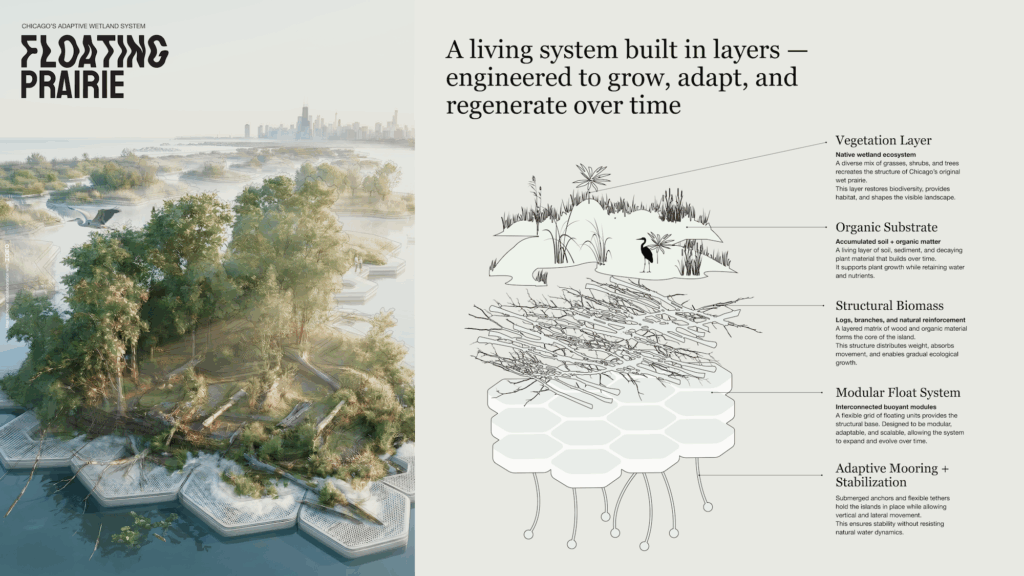
Each island is a self-contained buoyant module planted with native species, connected to adjacent units by flexible links that allow the system to move with wave action. Root systems filter runoff and create underwater habitat. The massed form of the archipelago dissipates wave energy before it reaches the shore. The system is deliberately modular and open-ended — islands can be added, repositioned, or reconfigured as conditions evolve, and the full 2050 shoreline is intentionally left undetermined.
Equity shapes the siting strategy from the outset. South Side neighborhoods — South Shore, Woodlawn, Bronzeville — bear the greatest climate exposure and have historically received the least green infrastructure investment. Prototype islands are prioritized there, with stewardship and construction jobs embedded in the program and school partnerships bringing students onto the islands as active participants.
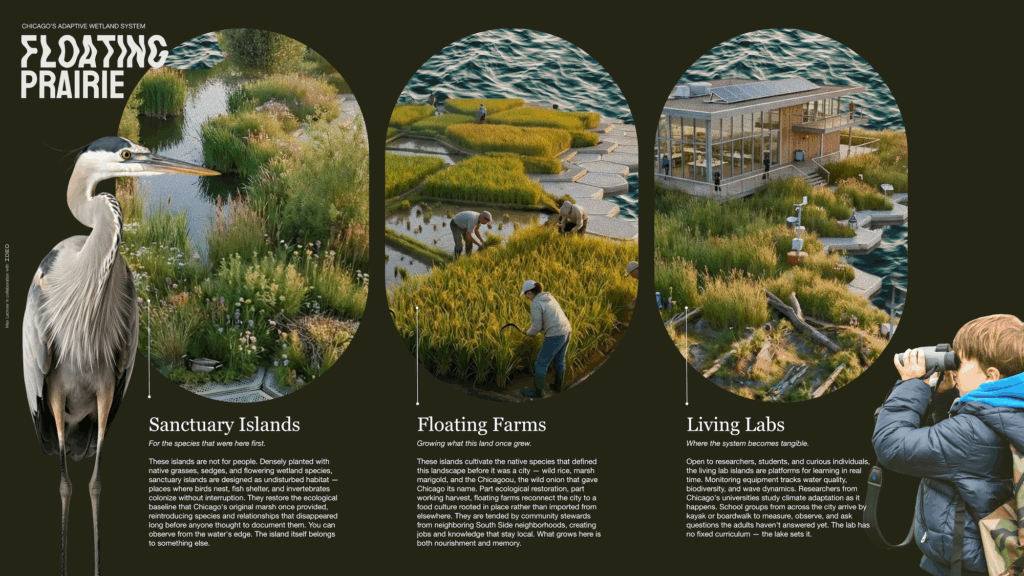
The path forward starts with a pilot: two or three prototype islands deployed along the South lakefront within three years, functioning as living experiments rather than finished solutions. It starts, as the proposal puts it, with a single island.
9. The Outer Loop
Team Name and Lead Organization: Olson Kundig – Chicago
Key Contributors:
Competition Design Team:
Allison Wurm, Associate, OK-CHI
Alex Kuchinskas, Architect, OK-CHI
Alexis Medrano-Ross, Architectural Designer, OK-CHI
Taylor Hagen, Senior Marketing Proposal Coordinator, OK-NYC
Competition Design Advisors:
Alan Maskin, Principal/Owner, OK-SEA, CHI, NYC
Kirsten Ring Murray, Principal/Owner, OK-SEA, CHI, NYC
David Mann, Director, OK-CHI
Ming-Lee Yuan, Principal/Owner, OK-SEA, CHI, NYC
Blair Payson, Principal/Owner, OK-SEA, CHI, NYC
Greg Rogers, Visualization Director, OK-SEA, CHI, NYC
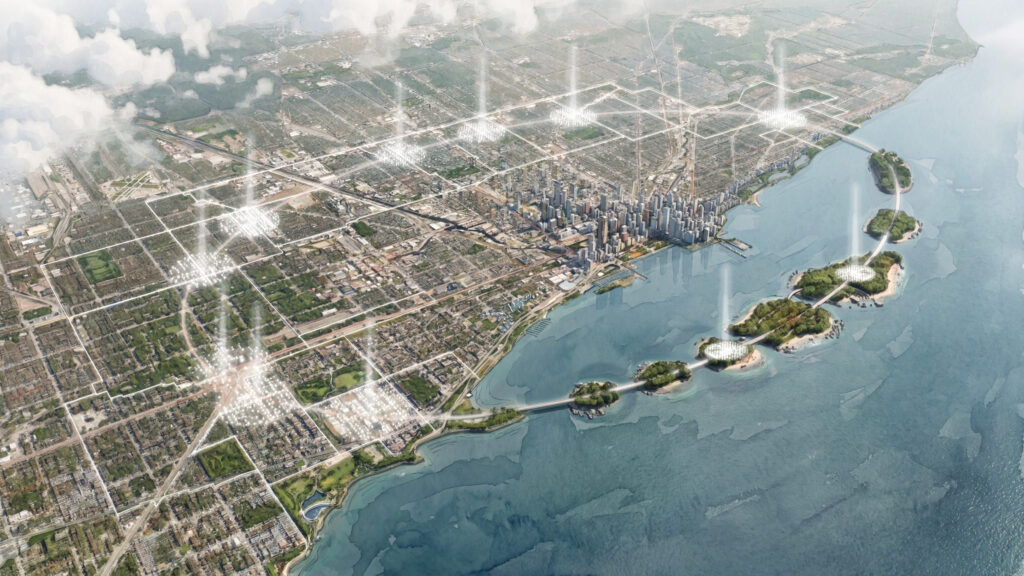
The Outer Loop proposes a fundamental reorientation of Chicago’s growth logic — away from the downtown core and toward the neighborhoods that connectivity has historically bypassed. At its center is a 34-mile below-grade high-speed rail line forming a ring around the city, linking north, south, and west side communities directly to one another without routing through the Loop.
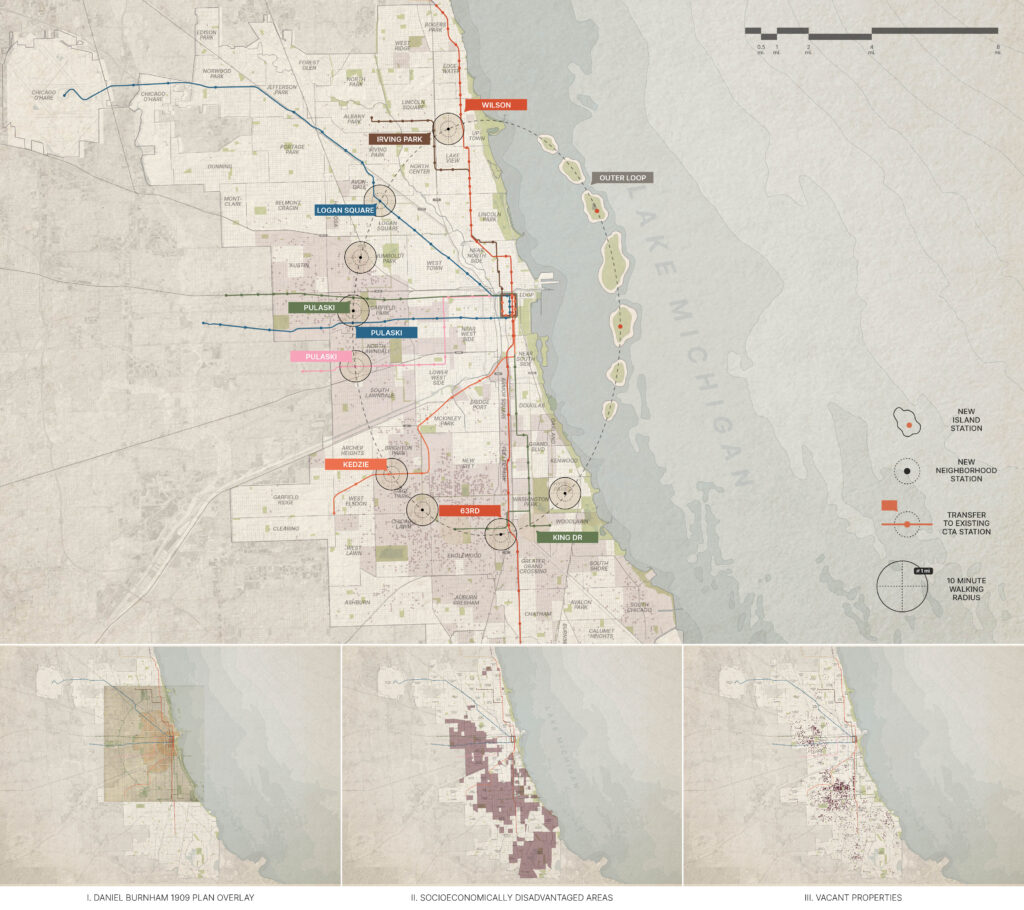
The proposal is explicitly framed as a successor to Burnham’s 1909 Plan of Chicago — invoking not just its physical ambition but its underlying social conviction that infrastructure exists to serve human flourishing. Where Burnham’s plan responded to rapid growth, the Outer Loop responds to a different urban reality: population decline, widespread vacancy, and a widening economic divide between the city’s north and south sides. The rail line is deliberately routed through areas of high disinvestment — Englewood, Fuller Park, Garfield Park, North and South Lawndale, Brighton Park — treating absence as opportunity rather than obstacle.
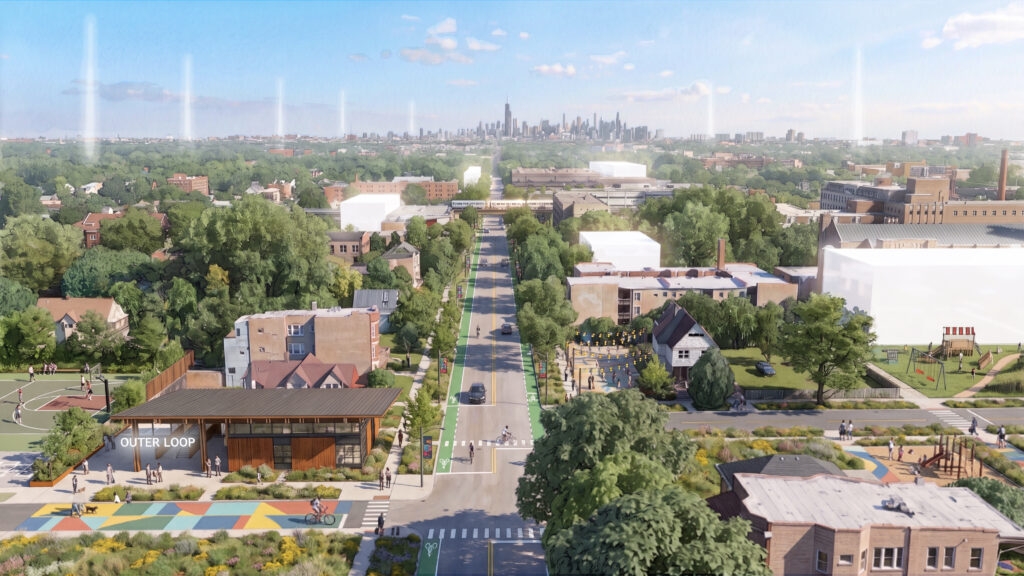
Each station functions as a neighborhood catalyst, not just a transit stop. Communities directly shape the program of their local node — affordable housing in one neighborhood, a childcare center or rehabilitated civic building in another. The city commits to delivering what residents choose, grounding an ambitious regional vision in hyperlocal accountability.
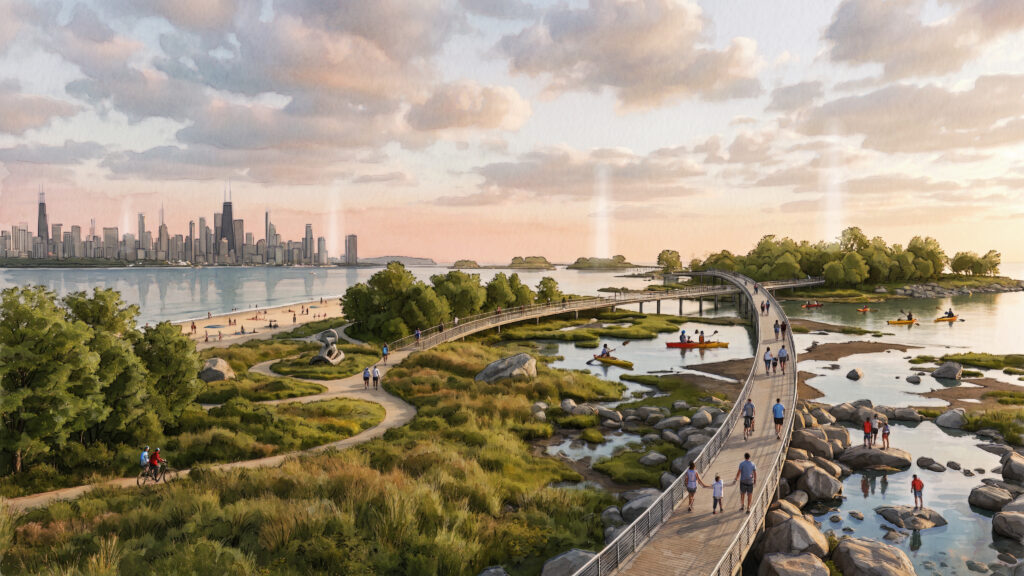
Where the loop extends east, it becomes something beyond transit infrastructure. A chain of offshore islands — constructed from soil excavated during tunnel boring — emerges along the lakefront, connected by a continuous pedestrian and recreational trail open to all Chicagoans. The islands serve double duty as natural breakwaters against rising lake levels and ecological habitat, echoing Burnham’s unrealized vision of offshore islands while reaffirming his conviction that the lakefront belongs to the people.
Implementation is phased and incremental, prioritizing segments with the greatest equity impact first and embedding the project within existing city planning, transit, and climate frameworks from the outset.
10. The Spine
Team Name: Jungle Co.
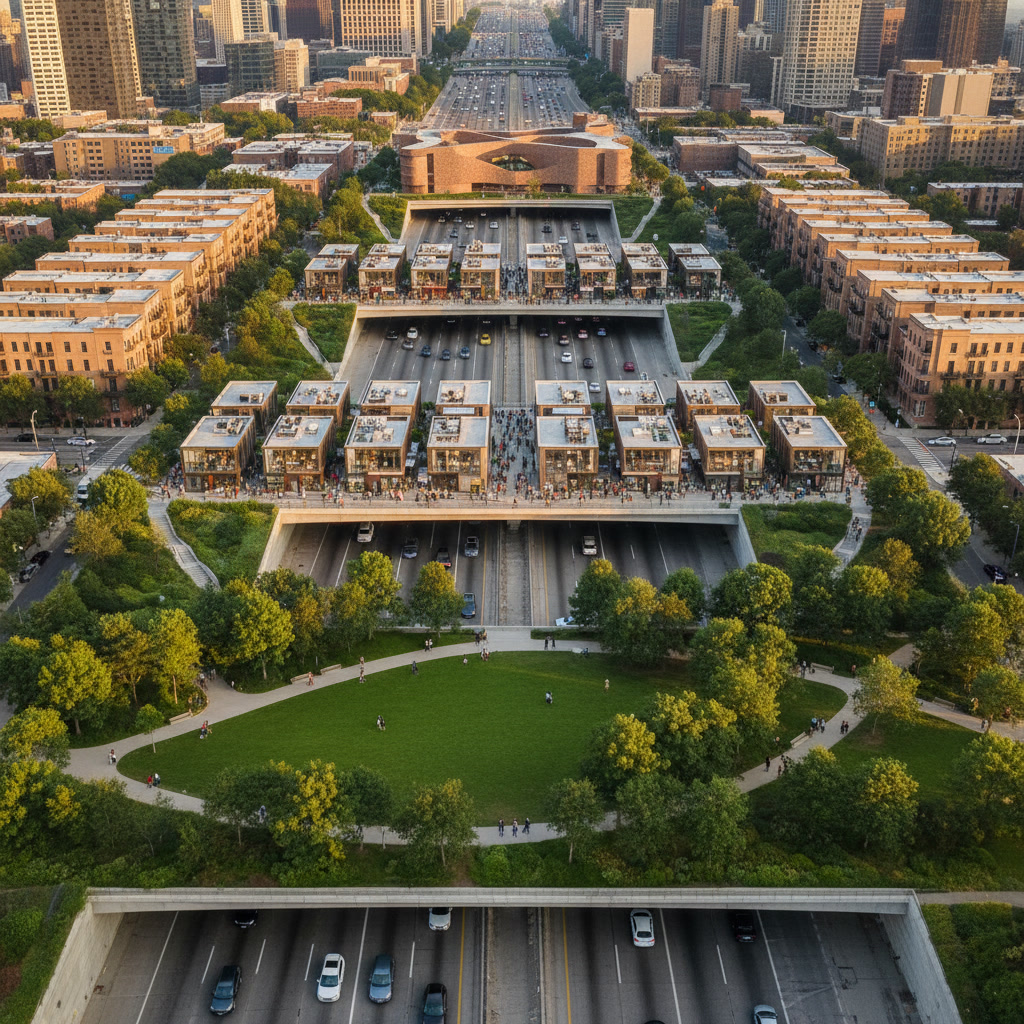
The Spine proposes transforming the Dan Ryan Expressway corridor into a connective thread for Chicago’s South Side — activating roughly 200 to 250 acres of vacant and underutilized land along State Street from the Loop to 95th Street through new housing, local manufacturing, and three strategic highway caps that stitch divided neighborhoods back together.
The Dan Ryan has long functioned as more than a road. It is a physical and psychological barrier cutting through communities that have borne disproportionate disinvestment for decades. The Spine treats the land flanking it not as residual infrastructure but as a development opportunity of significant scale — enough to accommodate an estimated 1,500 to 2,000 residential units and up to 250,000 square feet of retail and office space along State Street alone.
The proposal’s most distinctive element is its commitment to locally rooted construction. An on-site brick manufacturing facility would produce carbon-sequestering interlocking earth bricks from locally sourced soil, clay, and lime — reducing material costs, generating jobs within the corridor itself, and positioning the project as a model for community-anchored sustainable development.
Three highway caps at key intervals — near 35th, 63rd, and 95th Streets — provide the project’s civic backbone without closing the expressway. Each cap serves a distinct function: a green space and recreational park with inflatable seasonal enclosures for year-round use, a two-story marketplace featuring glass-fronted retail and dining stalls, and an entertainment and landmark venue honoring South Side culture and history. Together they serve as anchors for surrounding neighborhood development, including small hotels and local businesses.
The proposal draws on the proven public-private partnership model of Dallas’s Klyde Warren Park, adapting it to Chicago’s specific equity and infrastructure context — turning a corridor that has long divided the South Side into a unifying spine of opportunity.
11. The Prairie Quilt
Team Name and Lead Organization: HOK Chicago
Project Visionaries: Peter Ruggiero, Dallas Felder, Jonathan Zee
Design leads: Tommy Nam, Tyler Boyett
Design Team: Pengpeng Zheng, Patrick McManama, Saeed Sakhdari, Dessi Wang, Craig Bahney, Ali Senbas
Visualization Specialist: Marcin Rysniak
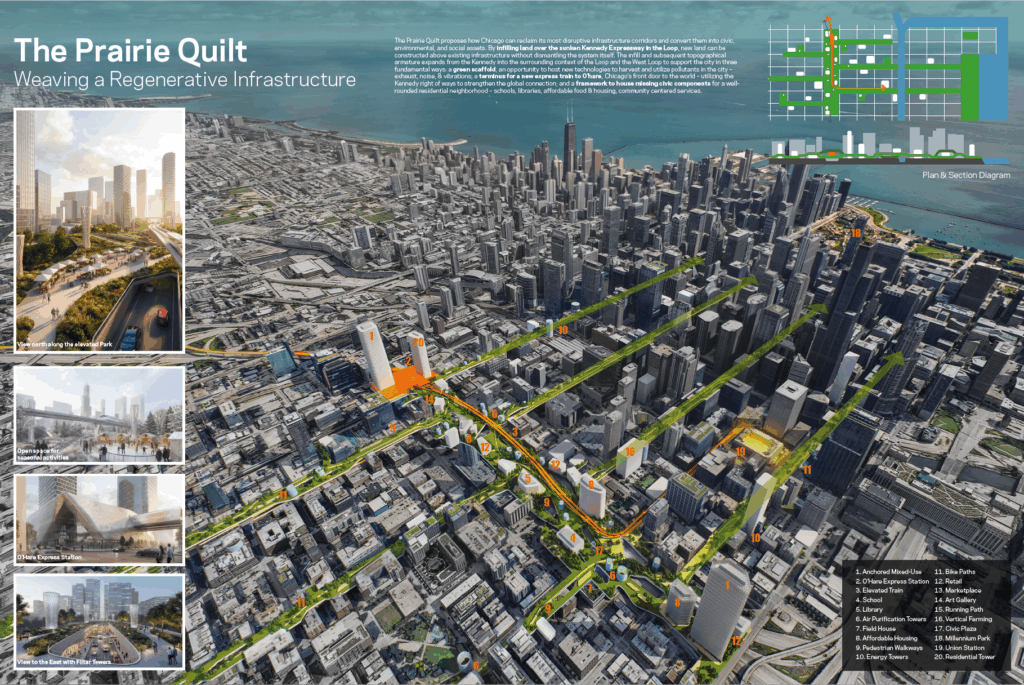
The Prairie Quilt proposes capping the Kennedy Expressway through the Loop and constructing an inhabitable landscape above it — transforming one of Chicago’s most disruptive infrastructure corridors into a continuous civic ground that reconnects the city east to west while addressing climate, public health, and equity simultaneously.
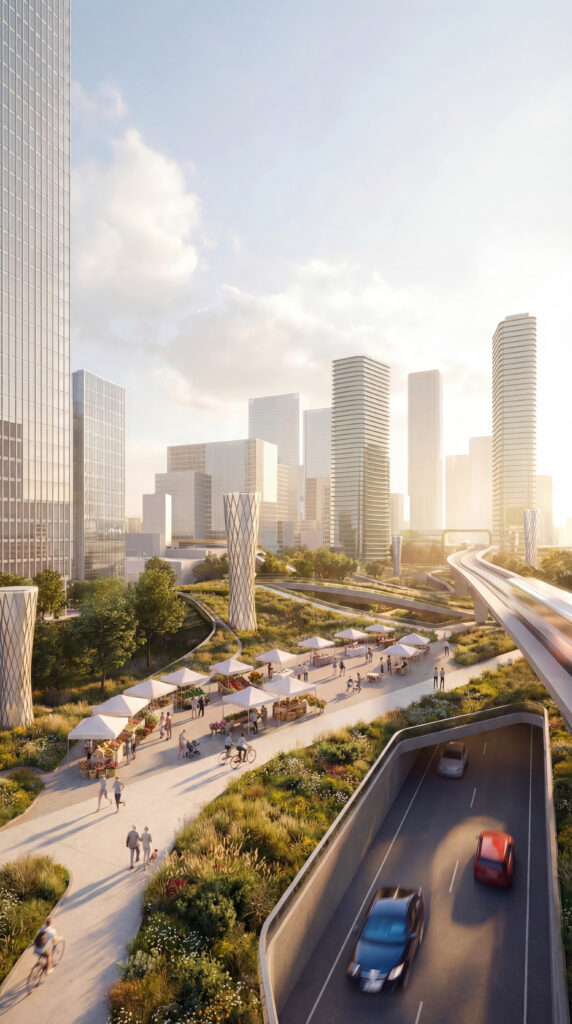
The premise is precise: where the Kennedy runs through a submerged trench, new land can be built above existing infrastructure without dismantling it. That trench condition represents one of the largest untapped spatial resources in downtown Chicago — and the Prairie Quilt treats it as raw material for a new kind of neighborhood rather than a permanent liability.
The project has three physical components: a structural deck infilled over the expressway trench, an undulating green carpet of public topography extending across the site and threading into surrounding blocks, and embedded civic amenities distributed throughout the landscape. A new O’Hare express rail station anchors the northern end, connecting through the site to Union Station. Rather than a single park or megastructure, the system thickens where programming is concentrated and thins where light and permeability take priority.
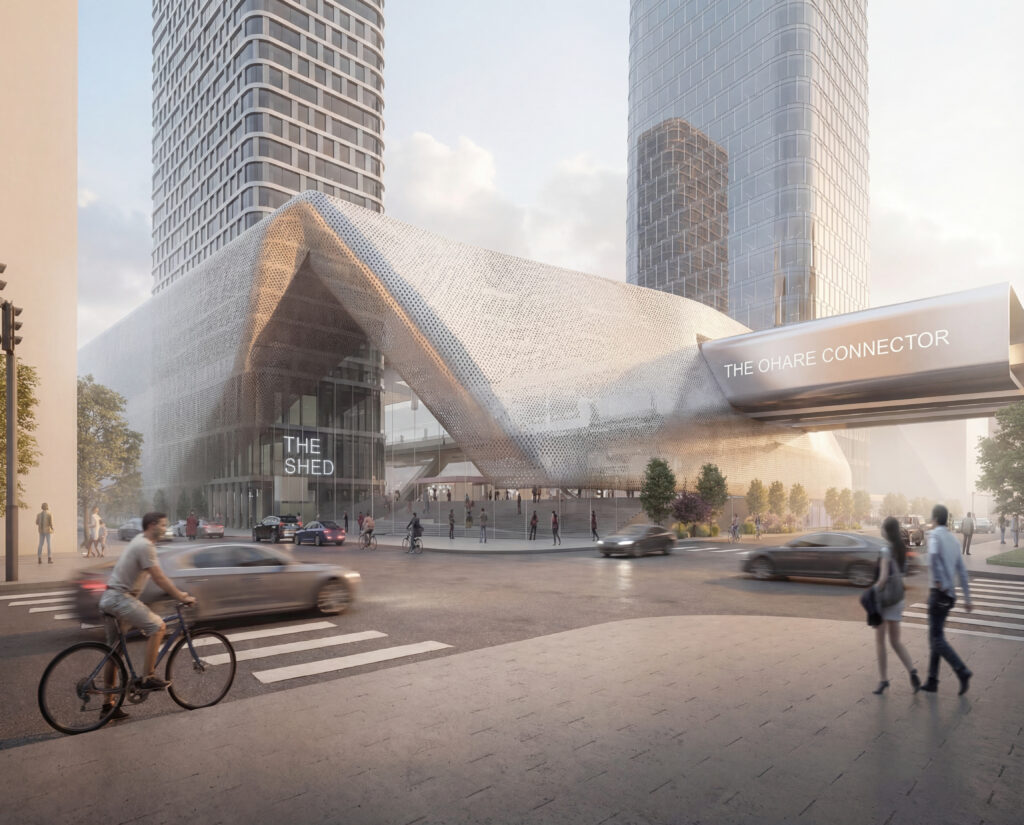
What distinguishes the proposal is its ambition to turn the expressway itself into an environmental asset. Carbon scrubbers integrated into the deck filter highway exhaust before it reaches public space above. Thermal exchange systems harvest heat from traffic and asphalt to power embedded buildings. Piezoelectric materials convert vehicle vibration into supplemental energy. Vertical “building snorkels” draw cleaner air down from higher elevations into interior spaces below.
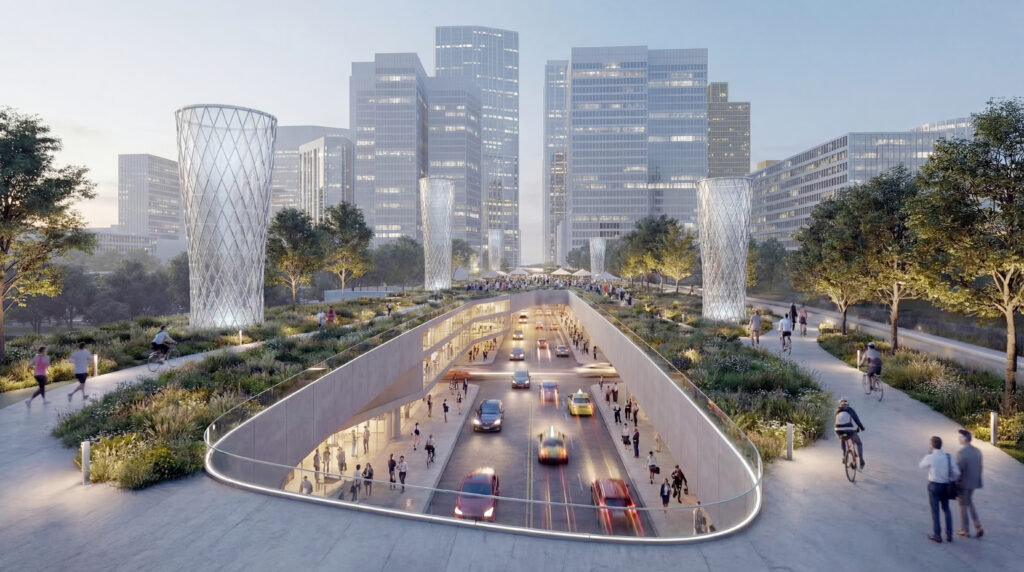
The civic programming is equally deliberate — targeting the everyday amenities the Loop currently lacks: public schools, grocery stores paired with urban agriculture, fieldhouses, a library, maker spaces, and performing arts venues distributed across the landscape rather than concentrated in a single complex.
The concept is explicitly designed to scale. Similar trench conditions exist along the I-290 corridor and various rail rights-of-way, positioning the Prairie Quilt as a replicable urban framework rather than a one-off intervention.
12. The Kennedy District: 9 new Parks for Chicago
Team:
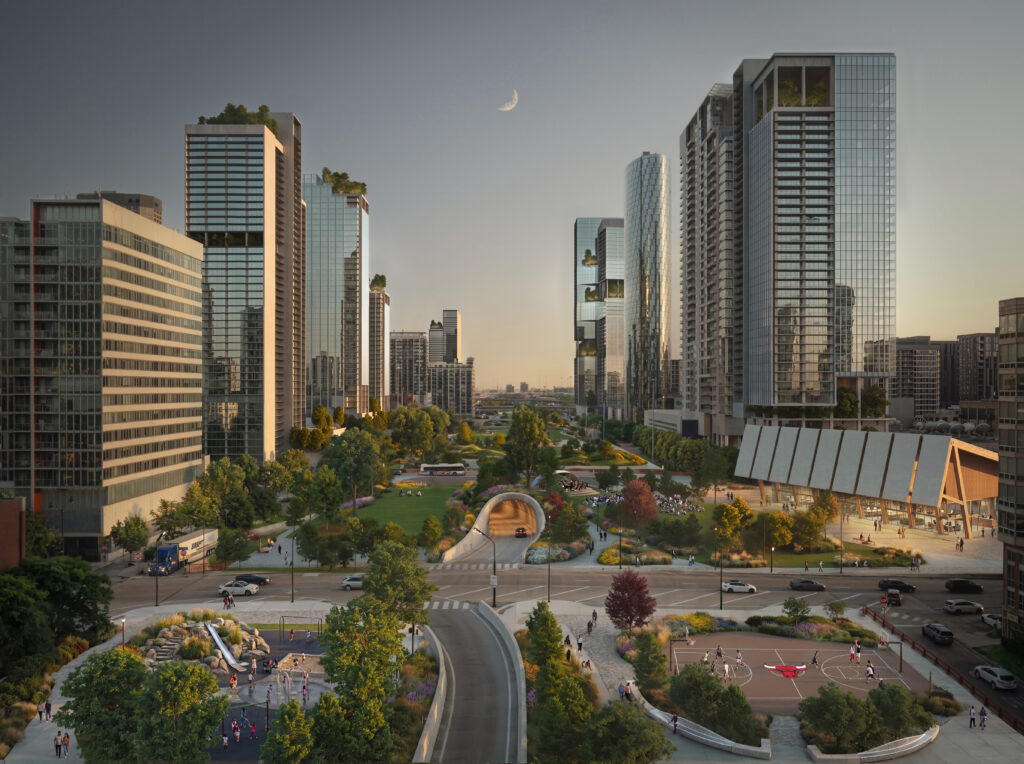
The Kennedy District envisions nine new parks built atop the sunken Kennedy Expressway through a series of capped “parcels” between Lake Street and Monroe — a 40-acre civic landscape nearly double the size of Millennium Park that transforms a century-old infrastructure scar into a globally recognized public space anchoring the near West Side.
The proposal is told through the eyes of a resident — a sleep-deprived parent walking a dog at dawn, discovering a flyer announcing the opening of Parcel 6 in 2036. It’s a deliberate narrative choice that grounds an ambitious urban infrastructure project in the texture of ordinary neighborhood life: basketball courts, a Berlin Philharmonic performance, long walks with a dog through parks that have been opening practically every year since the family moved in.
Each of the nine parcels carries a distinct design identity and civic purpose — green lawns for outdoor concerts and farmers markets, sports courts, playgrounds, dog runs, a performing arts center, a public library branch — while sharing a common environmental infrastructure beneath the surface. Stormwater mitigation, carbon capture, native wildlife support, clean electrical generation, and greywater irrigation from adjacent new buildings are embedded within the landscape, largely invisible from above. New crosswalks, five miles of bike lanes, and carefully calibrated street lighting complete the street-level transformation of Washington Boulevard into a connective passage between the West Loop, Fulton Market, and downtown.
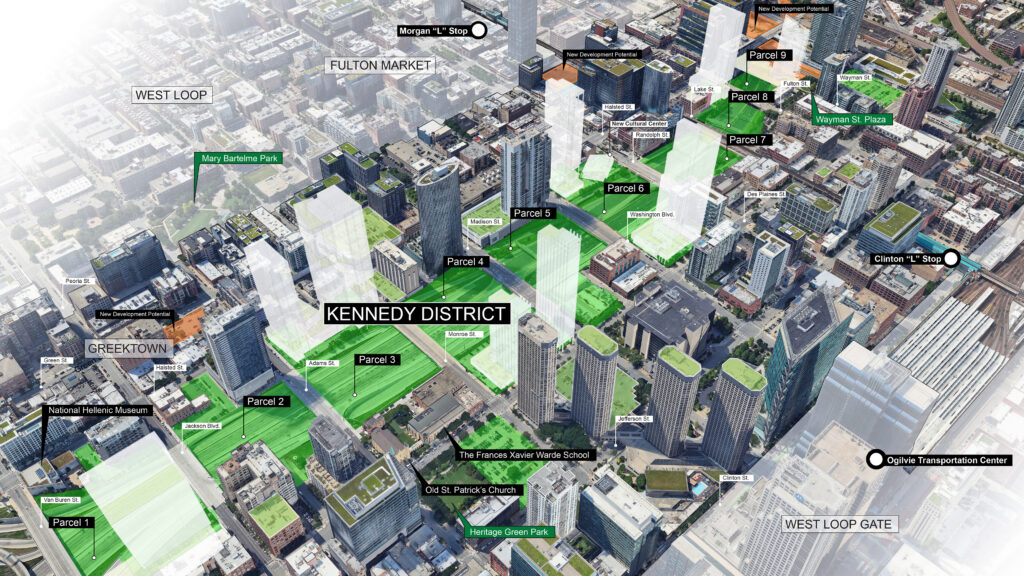
Equity and community specificity shape the design throughout. The proposal explicitly centers working families, UIC students, Greektown business owners, Ogilvie and Union Station commuters, and local pollinator ecosystems as equal constituencies in the park’s design calculus. Strategic zoning tied to the initiative has already produced 1,200 new housing units, nearly half affordable.
The Kennedy District is framed not as a one-off project but as a prototype — a proof of concept for capping expressway corridors citywide, with miles of I-290, I-55, and I-90/94 identified as future candidates for the same treatment across Chicago’s south, west, and northwest sides.
13. Thomas A. Dorsey Museum of Gospel Music Heritage
Key Contributors:
Andre Garner – The Black eXperience, LLC & GoodWorX, NFP
Craig Barnes – The Black eXperience, LLC
Adrienne Garner – GoodWorX, NFP
Steve “Silk” Hurley – S&S Records
Sean Long – TV Exec- Documentarian
Sondra Thomas – Gospel Music Librarian
Heather Ireland Robinson – Jazz Institute
Desmon Walker – Narratent Marketing
DeJaundre Meekins – TBM360 Marketing
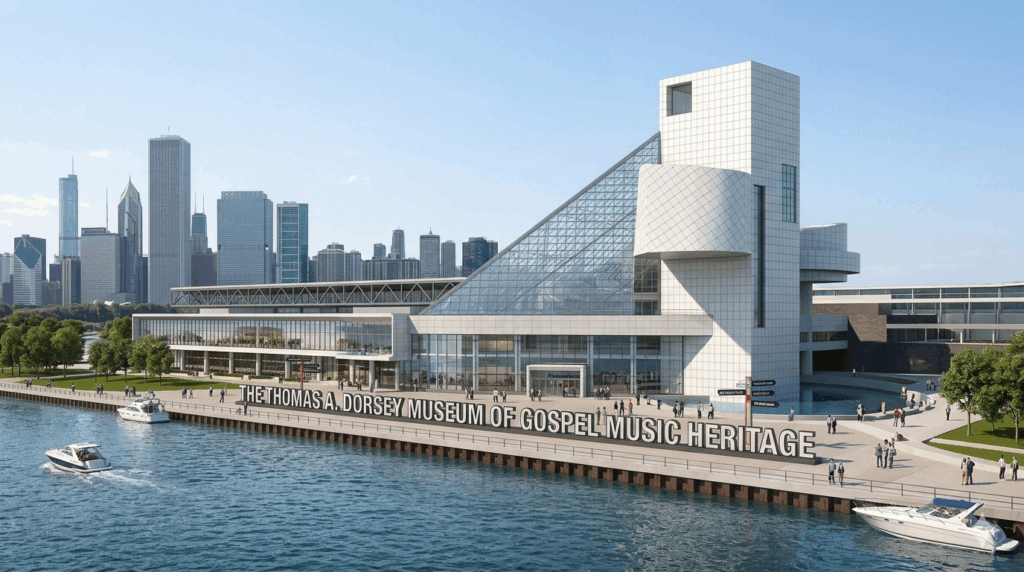
The Thomas A. Dorsey National Museum of Gospel Music Heritage proposes a new cultural institution on Chicago’s Museum Campus — one dedicated to Gospel music and its sweeping influence on Blues, Jazz, Soul, House Music, and the broader landscape of American artistic and civic life.
The museum takes its name from Thomas A. Dorsey, the Chicago-based composer widely regarded as the father of Gospel music, whose legacy serves as the conceptual and historical foundation for the institution. But the scope extends well beyond a single figure or genre. The Dorsey Museum would celebrate Gospel’s role as a generative force — a root system from which some of the most globally influential music traditions have grown — while honoring the producers, record executives, publications, churches, universities, record labels, films, and businesses that carried these art forms into the mainstream.
An annual enshrinement program would recognize legendary artists and industry figures across all represented genres, giving the museum an ongoing, living relationship with the communities and traditions it celebrates — and a recurring cultural moment that brings those communities back to Chicago’s lakefront year after year.
The proposed site is the Lakeside Center at McCormick Place, the oldest building on the campus, completed in 1971 and currently underutilized. Adaptive reuse of this existing structure positions the Dorsey Museum as both a cultural investment and an architectural renewal — breathing new purpose into a building that has long sat at the edge of one of Chicago’s most visited institutional destinations.
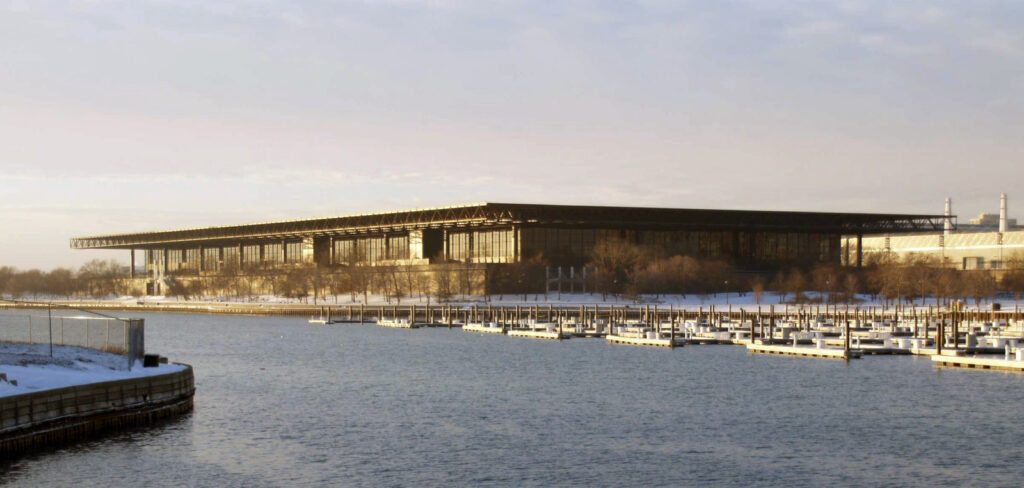
Placed on the Museum Campus alongside the Field Museum, Shedd Aquarium, and Adler Planetarium, the Dorsey Museum would fill a meaningful gap: a world-class institution dedicated to Black American musical heritage and its global reach, anchored in the city where so much of that heritage was made.
14. Museum of House
Key Contributors:
Cameron Phillips — President and community organizer; vision, partnerships, and cultural strategy
Lauren Lowery & Lori Branch — Founders, Vintage House Show; archival preservation
Vince Lawrence & Joe Smooth — Chicago house music pioneers; cultural authenticity
Frederick Dunson — President, Frankie Knuckles Foundation, foundational legacy and global impact
John Curley & Seamus Doheny — ARC Music Festival; talent curation and large-scale production
Jason Lesniewicz — Choose Chicago; domestic and international tourism promotion
Pioneer DJ & Roland — Technology partners; studio spaces and educational programming
Jeremy Hodges — Founder, Project Arts Collective, museum design and development
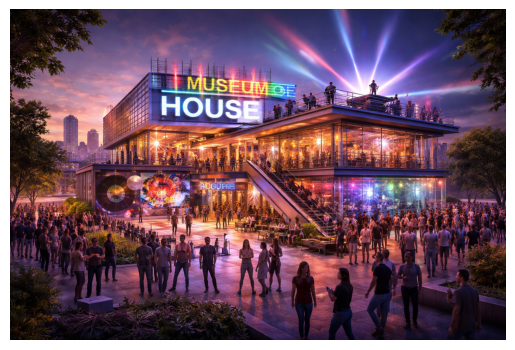
The Museum of House proposes a permanent cultural institution in Chicago dedicated to house music — the genre born in the city’s South and West Side clubs that has since grown into one of the most influential musical movements on earth. Despite that global reach, Chicago has no world-class institution to claim or preserve that legacy. The Museum of House addresses that gap directly.
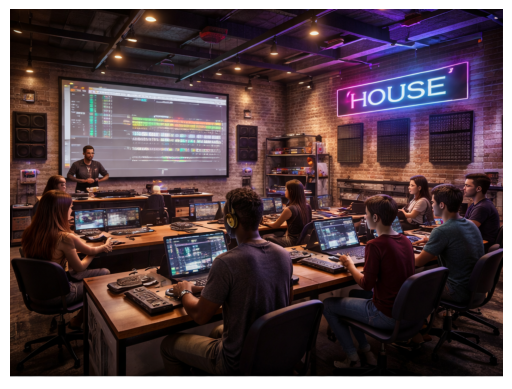
The museum’s core mission is preservation and presentation: immersive exhibits tracing the origins of house music through Chicago’s underground club culture, the pioneers who defined its sound, and the communities — primarily Black and LGBTQ+ — who built the movement. Many of the original artifacts, stories, and voices that shaped the genre are at risk of being lost, and the museum would create the infrastructure to protect them with cultural authenticity intact. The narrative extends outward from Chicago to trace house music’s evolution into a global phenomenon spanning countless subgenres and scenes across continents.
But the proposal frames the museum as a living platform, not a passive archive. A talent incubator embedded in the institution would develop the next generation of DJs, producers, sound engineers, event promoters, and creative directors — connecting emerging talent directly to real performance opportunities across Chicago. A Chicago-based international dance music award show would bring global industry attention to the city annually, reinforcing its claim as the definitive capital of house music culture.
The economic case is explicit. Cities like London and Ibiza have built substantial tourism economies around electronic music culture. Chicago, despite being the genre’s birthplace, has not yet fully leveraged that identity. The Museum of House would provide a permanent, year-round destination anchoring that interest.
The preferred location is the West Side — rooted in the geography of the music’s origins and positioned as a catalyst for reinvestment in historically underserved communities. A four-phase implementation plan moves from partnership-building and community engagement through pop-up programming, permanent site development, and full institutional launch.
15. Blueway
Team Name and Lead Organization: Edward PECK DESIGN
Edward M. Peck, FAIA — Founder and Design Director; architecture, materials innovation, interdisciplinary collaboration
Miko Zajda — Senior designer; urban regeneration, large-scale commercial and residential development
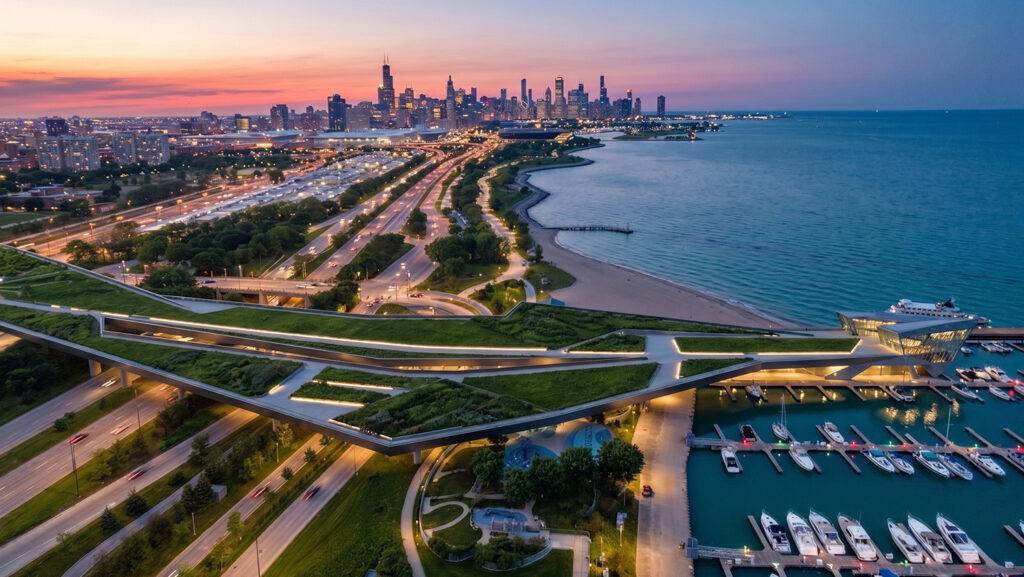
Blueway proposes reimagining Chicago’s entire lakefront — from Evanston to the far South Side — as a continuous, multi-layered civic system that finally resolves the long-standing tension between DuSable Lake Shore Drive as both vital artery and persistent barrier.
The plan has two primary components working in tandem. A series of landscape bridges spans the Drive at key intervals, reconnecting dense inland neighborhoods to the lakefront. These are conceived as genuine public spaces rather than simple pedestrian crossings — framing lake views, supporting recreational use, and establishing a continuous green relationship between the city and the water’s edge. 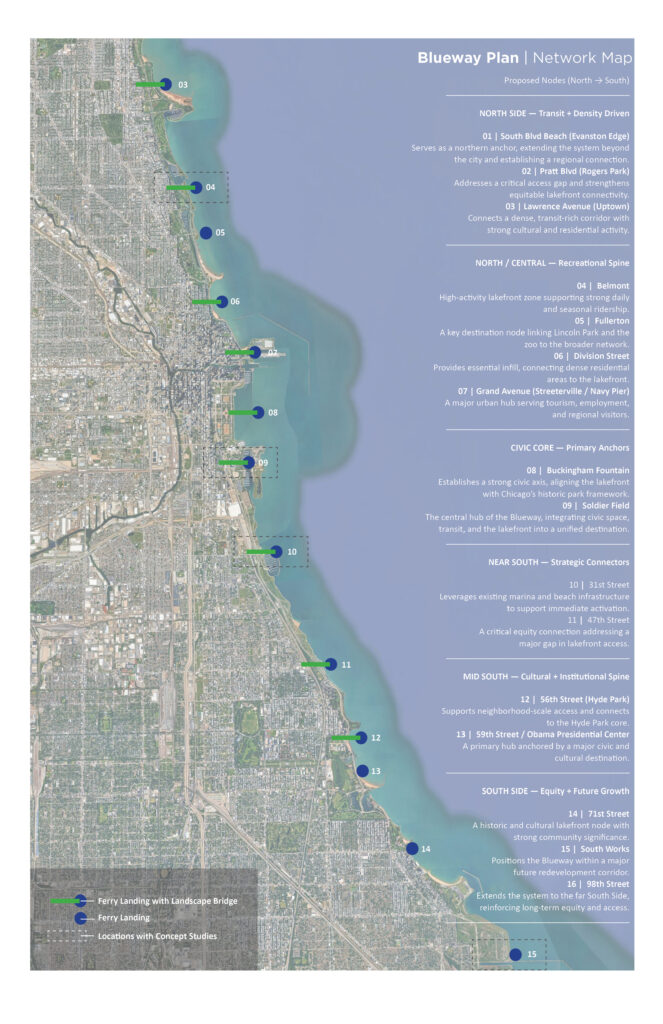
The second component is a new electric ferry network threading the lakefront together from north to south. A fleet of quiet, zero-emission vessels — ranging from small, high-frequency neighborhood shuttles to larger commuter ferries — would introduce water transit as a legible, citywide mode of transportation. The proposal frames the ferry journey itself as a defining civic experience, not merely a functional alternative to road travel.
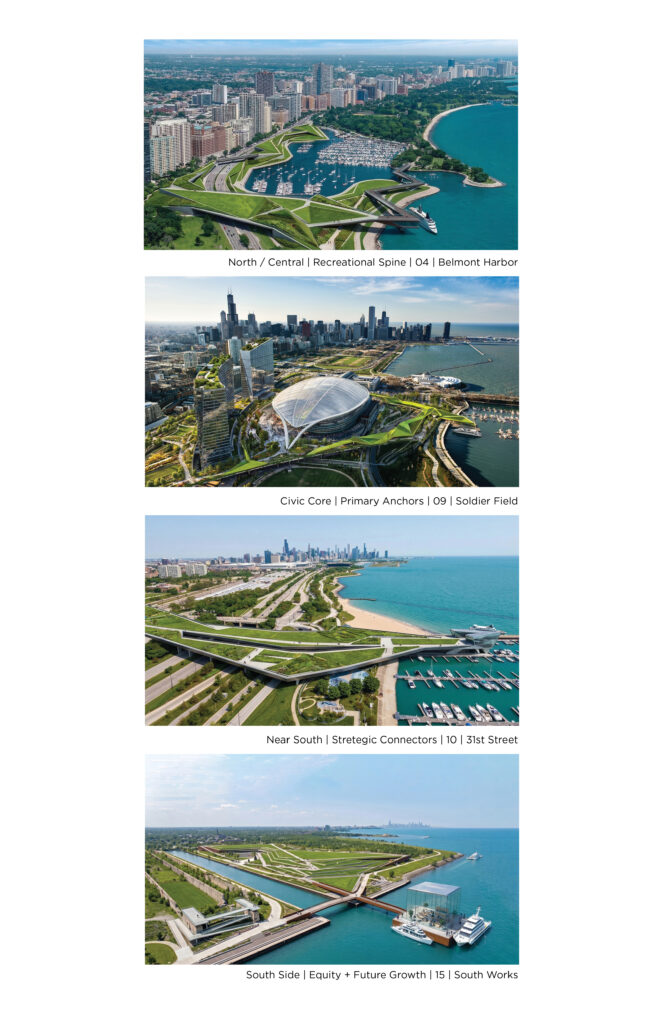
Together, these two systems address the same underlying condition from different angles: Lake Michigan is simultaneously Chicago’s most iconic geographic feature and one of its most physically inaccessible. The waterfront is ever-present on the horizon but severed from daily neighborhood life by a high-speed road corridor. The Blueway Plan treats that disconnection as the central design problem, repositioning the lake from scenic backdrop to active civic infrastructure — a transportation network that retains its expansive, calming character while becoming genuinely woven into how the city moves and gathers.
16. River Rhythms
Team Name and Lead Organization: ChromaFlow Studio
Kristen Youngman — Lead Artist and Project Director; founder, ChromaFlow Studio; immersive design and ecological communication
Zachary Damato / Urban Rivers — River operations and community partner; Chicago River environmental consulting, floating habitat expertise
Mycology Research Partner — TBD; species selection and substrate design for fungal bioremediation
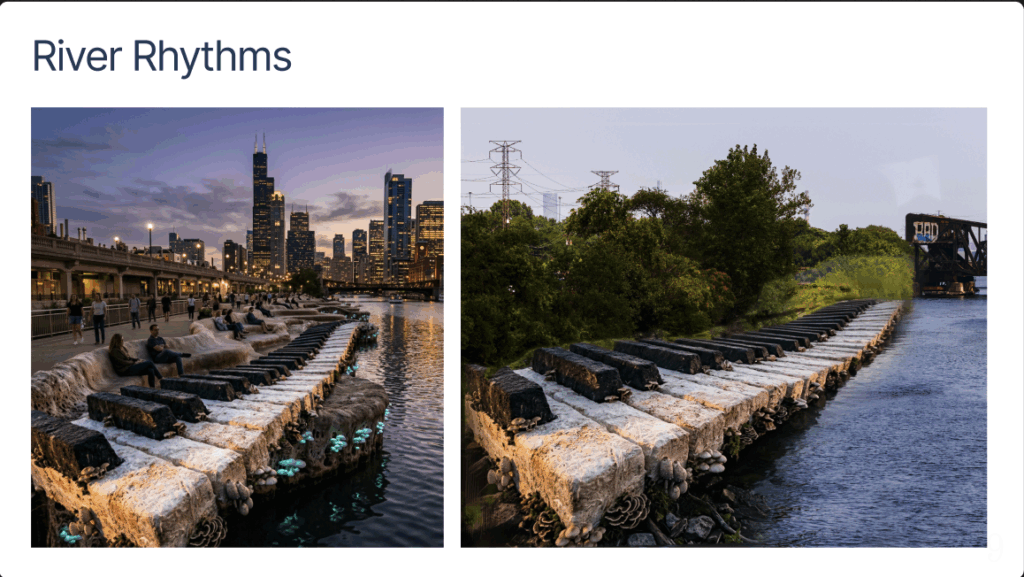
River Rhythms proposes a network of mycelium filtration sculptures along the south and west branches of the Chicago River — monumental, functional installations that intercept stormwater contamination at the precise moment it enters the water, transforming neglected riverbanks in historically underserved neighborhoods into public destinations.
The ecological problem the project addresses is specific. Chicago’s most persistent water quality challenges don’t come primarily from industrial discharge — they come from the accumulated chemistry of a modern city washing off its streets in every rainstorm: road salts, petroleum residue, heavy metals from brake dust, pharmaceutical compounds, and bacteria from overwhelmed combined sewers. All of it flows downhill and enters the river at thousands of small points along its banks. River Rhythms targets exactly those entry points.
The sculptures take the form of monumental piano keys — alternating tall white and shorter dark forms made of mycelium-grown biomaterial — cascading from the bank down to the water’s edge. The white keys are broad and sittable, oriented toward the river. The darker forms channel runoff through active mycelium substrate inoculated with fungal species matched to Chicago’s specific contaminant profile, degrading heavy metals, petroleum compounds, and bacteria before the water reaches the river. The underlying science, mycofiltration, has received EPA research funding and peer-reviewed validation for urban stormwater applications.
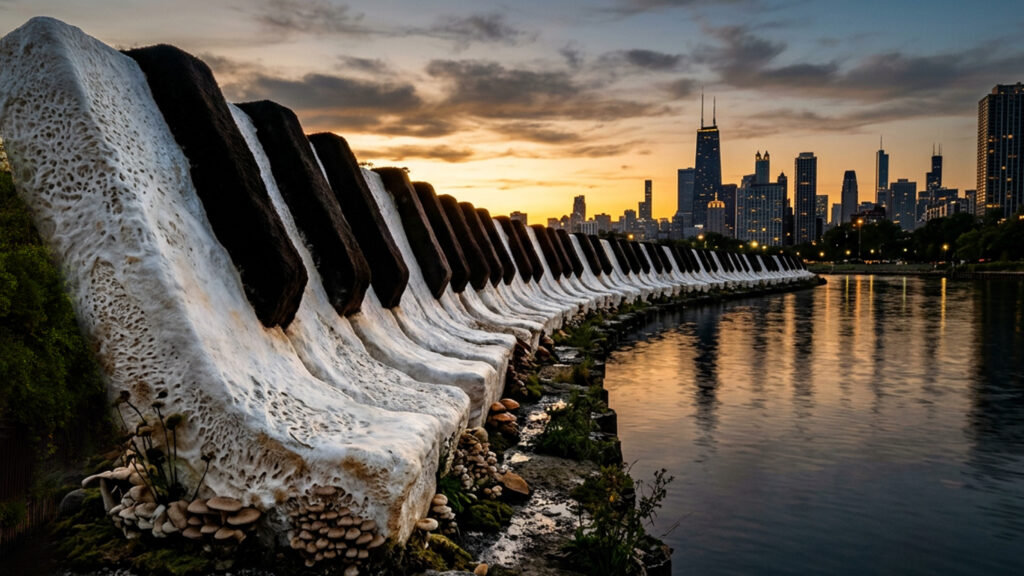
The sculptures are also alive in a visible way. After rain, mushrooms fruit seasonally from the substrate faces — oyster and shelf fungi emerging from the dark forms between the keys — making the ordinarily invisible labor of ecological remediation briefly and dramatically apparent.
Sited along the south and west branches where the river has long been barrier rather than amenity, the installations create a reason to go to the water’s edge in neighborhoods that have historically had the least access to it. By 2050, the vision is a continuous network along the full river system — infrastructure that deepens in filtration capacity as fungal networks mature, and that doubles as a living laboratory for ongoing water quality research.
17. The Bronzeville Conservatory – Chicago’s Third Conservatory
By: Justus Pugh, World Business Chicago
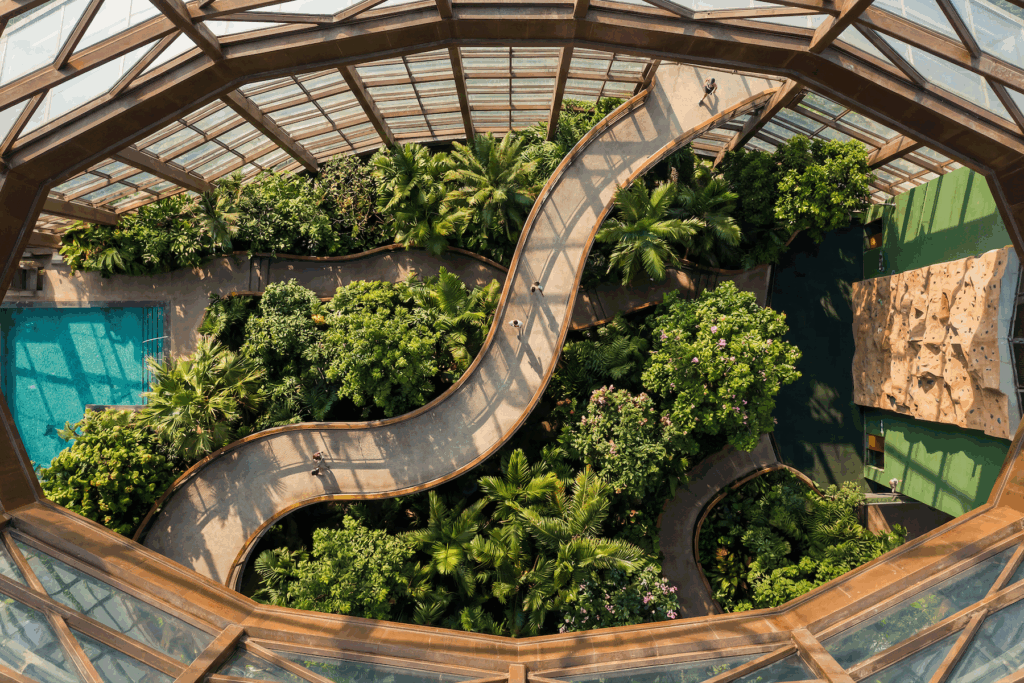
The Bronzeville Conservatory proposes Chicago’s third major nature conservatory — joining Lincoln Park and Garfield Park — on the former Michael Reese Hospital campus between 26th and 31st Streets on the South Side lakefront, filling a long-standing geographic and equity gap in the city’s public green infrastructure.
The centerpiece is a soaring glass structure housing a one-mile indoor nature trail inspired by Singapore’s Gardens by the Bay, winding through multiple levels of immersive biomes. More than half would highlight Midwestern ecological heritage — Illinois tallgrass prairie, Michigan pine forests, and a reconstructed version of the landscape Jean Baptiste Point DuSable encountered upon arriving in the region. The remaining gardens draw on Chicago’s Sister Cities relationships, offering Japanese, Ghanaian, and Mexican landscapes that root a global botanical experience in Chicago’s identity as an international city.
Woven throughout the plant-filled interior is a full suite of recreational amenities: a competition-ready swimming pool, rock-climbing wall, calisthenics stations, and cross-training equipment — all designed to evoke the feeling of being outdoors, just with a roof and climate control. For Chicago’s growing running community, the indoor mile trail becomes a warm, beautiful winter refuge. The integration of nature and movement is framed explicitly as a public health strategy, addressing the physical inactivity, social isolation, and disconnection from green space that disproportionately affects South Side residents during winter months.
Beyond recreation, the Conservatory functions as a community anchor: flexible event spaces, environmental education classrooms, a youth training center in horticulture and sustainability, and an outdoor farmers market plaza along 31st Street. Its location between Illinois Tech and the 31st Street Beach and Marina creates a natural activity corridor along one of the South Side’s most promising redevelopment stretches.
A ten-year implementation timeline moves from community engagement and feasibility through design, permitting, and construction, targeting an opening by year ten through a public-private partnership anchored by the Chicago Park District.