
WONDERWAYS! Reimagining Chicago’s Boulevards as a Network of Climate Commons
Horizon Lines Finalist
By MKSK
Key Contributors:
MKSK | Donny Zellefrow, AICP – Associate, Urban Designer
MKSK | Donny Donoghue, AICP – Associate, Urban Designer & Planner
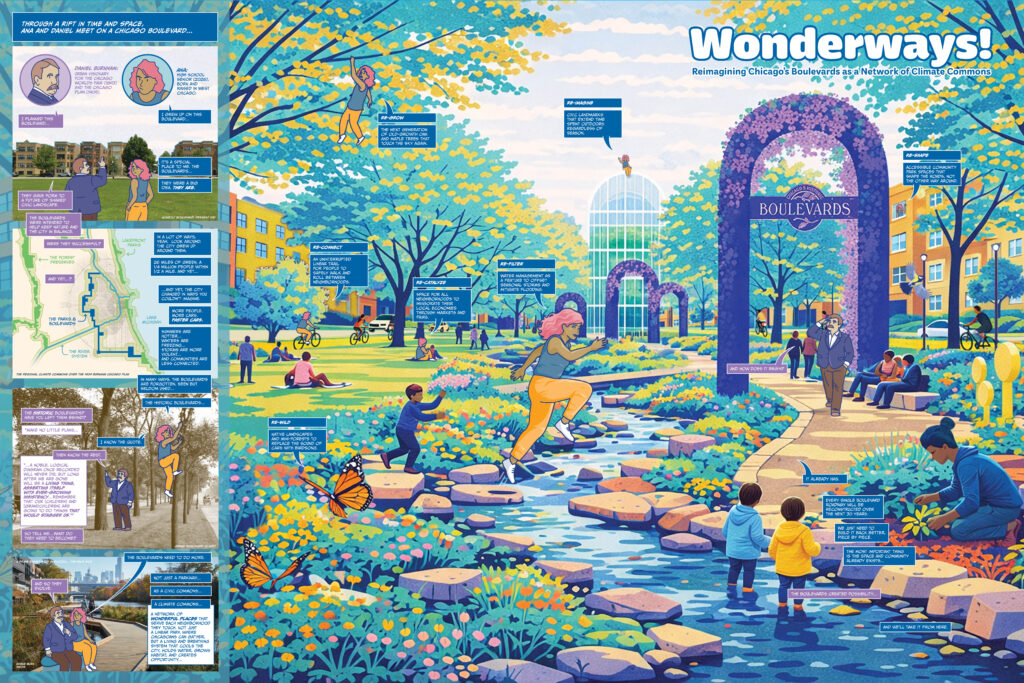
Chicago has long been defined by its ability to translate bold ideas into built form. From the reversal of the river to the construction of its skyline and the creation of its boulevard system, the city has repeatedly used infrastructure to shape not only how it functions, but how it lives. The Historic Boulevards, first conceived in the late nineteenth century, were among the most ambitious of these efforts. They stitched together parks and neighborhoods through a continuous green thread, offering access to fresh air, open space, and shared identity across a rapidly growing city.
Today, Chicago faces a new set of challenges that demand a similarly ambitious response. Rising temperatures, increased storm intensity, and more volatile seasonal patterns place strain on the city’s infrastructure and its residents. These impacts are not evenly distributed. Neighborhoods with limited tree canopy, aging infrastructure, and constrained access to quality public space are disproportionately exposed to extreme heat, flooding, and environmental stress. At the same time, many of the systems designed to address these challenges remain largely invisible, overburdened, and disconnected from daily life.
This proposal reframes how Chicago responds to climate change by making adaptation visible, local, and shared. Wonderways positions the historic boulevard system as a central part of a regional Climate Commons, a distributed system of public spaces that combines ecological performance with everyday social use. Rather than functioning solely as corridors for movement or monuments of the past, the boulevards evolve into a new layer of civic infrastructure that supports environmental resilience while strengthening community life.
Each boulevard responds to the needs and desires of the adjacent residents, and is designed as a place where ecological function, public health, and daily human experience are inseparable. In the summer months, expanded tree canopy and layered planting systems provide shade and reduce ambient temperatures while absorbing stormwater and filtering pollutants. These landscapes create spaces that invite gathering, play, and curiosity. Continuous trails support safe walking and biking between neighborhoods, weaving through restored prairie landscapes and micro-forests that restore habitat and improve soil health. Adaptable plazas intersect neighborhood commercial streets and create opportunities for cross-neighborhood economic and cultural exchange through sidewalk vendors, outdoor markets, and local events.
In the winter the system reveals a different kind of performance. Landforms create opportunities for sledding and play, while strategic planting mitigates wind and maximizes solar gain. A new generation of civic buildings along the boulevards extends seasonal use and supports outdoor activity even in colder conditions. These spaces are not just seasonal amenities, but year-round environments that support daily life across Chicago’s increasingly extreme climate.
The boulevard system provides a uniquely practical foundation for citywide impact. Spanning 28 miles and over 500 acres across dozens of culturally, racially, and socio-economically diverse neighborhoods, it offers an existing and connected framework for distributing climate adaptation equitably across the city. Within this framework, the Wonderways operates at multiple scales. The boulevards function as uninterrupted environmental corridors, while directly improving conditions for the 250,000 residents and over 50,000 children that live within half a mile. Easy-to-access natural areas, parks, and schoolyards are linked as one public and environmental health feature breathing life and vitality across the city.
The boulevards remain as a critical part of the citywide roadway network but are re-shaped corridor by corridor to better balance priorities. Roadways are consolidated where possible, intersections are simplified, and public space is expanded to remove barriers, improve desirability, and maximize utility for Chicagoans of all ages and abilities.
Implementation begins with targeted pilot segments in areas of greatest need, including neighborhoods with historic underinvestment, high heat vulnerability, limited canopy coverage, and recurrent flooding. These early projects test the spatial, environmental, and social potential of the Wonderways while building public support and institutional alignment. Through performance monitoring and public feedback over time, new segments are brought online and optimized, gradually forming a continuous network.
Essential to its viability, this system does not require entirely new systems but instead leverages existing ones. It builds on annual capital improvement programs, street reconstruction cycles, park investments, and public right-of-way projects. By coordinating these efforts under a unified vision, the city aligns public investment toward a cleaner, healthier, and more resilient future.
This approach is both ambitious and practical. It is immediate and scalable. It builds on Daniel Burnham’s historic legacy and the Chicago “Urbs in Hortos” ethos that the city is as much about balance with nature and civic life as it is for brute infrastructural function. The original boulevards reflected a belief that access to nature and shared public space was essential to the identity and health of the city. The Wonderways extends that belief, linking historic ambition to contemporary need.
By 2050, Chicagoans will move through a city where climate adaptation is visible and shared. The boulevards will be experienced as active, ecology-forward public spaces embraced as is the forever free, open, and clear lakefront. Residents and visitors will bike, walk, gather, and recreate along these continuous green corridors that provide relief in the summer, comfort in the winter, and connection year-round.
Chicago has created a world class city from the ethos of “make no little plans”. The Wonderways is yet another step in the City’s legacy of bold thinking, offering a new model for a more resilient, equitable, and livable future.