
RE-LOOP: THE LIVING MILE
Horizon Lines Finalist
By The Re-Loop Vision Coalition
Lead Chicago-based Organization: Loop Layer, LLC
Key Contributors: Garr Punnett Lead Strategist & Visionary: Founder of Loop Layer and circular economy strategist, entrepreneur and consultant.
Chicago Tool Library – Tessa Vierk
Working Bikes – Tom Mulhern
Plant Chicago – Jonathan Pereira
EcoShip – Aleksandra Plewa
Rheaply – Dr. Garry Cooper
Build Reuse – Daniel Kietzer
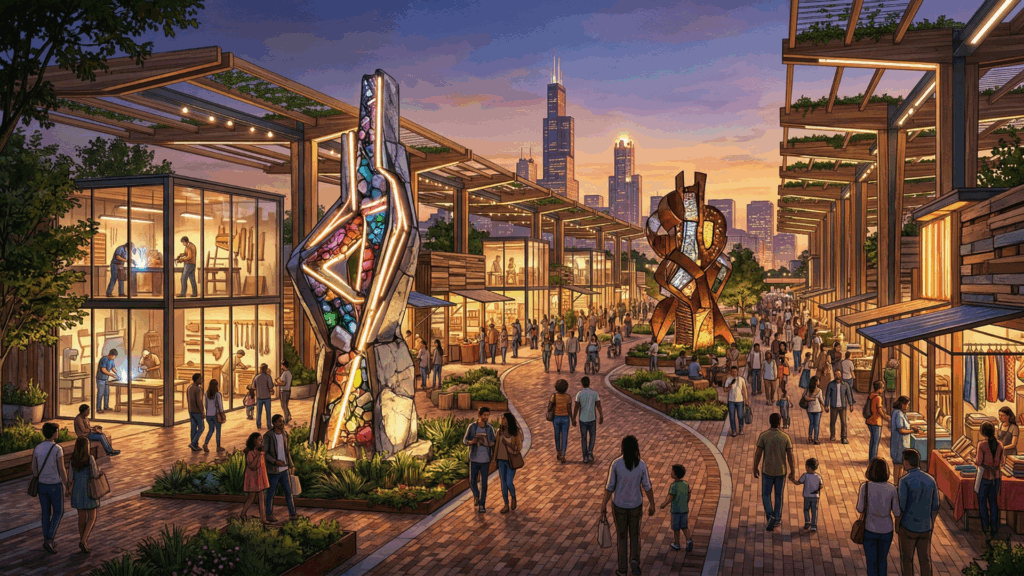
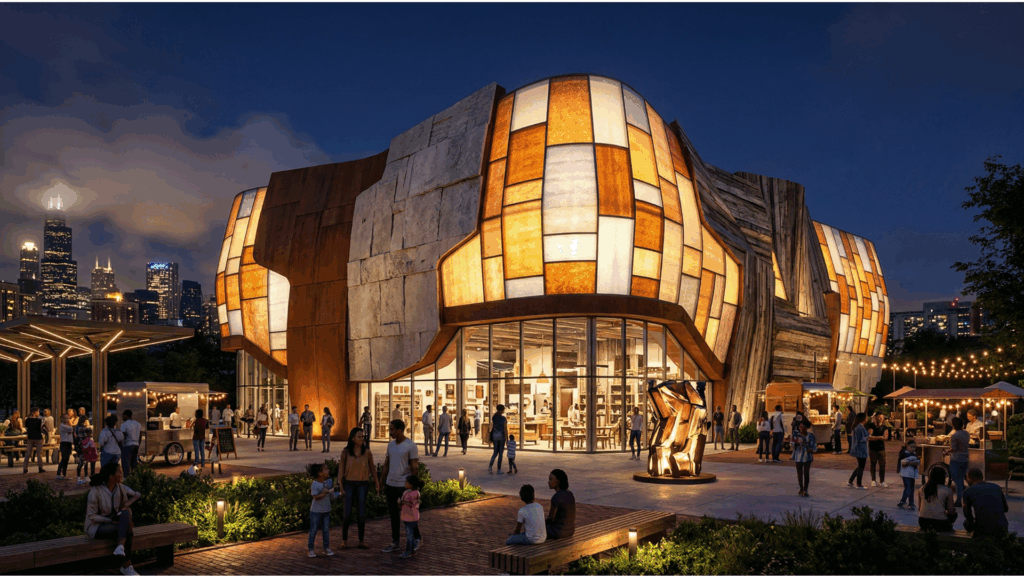
Chicago has always known how to build big. What it hasn’t tried yet is building something that grows the way the city itself grows. Block by block, season by season, voice by voice. Re-Loop is that idea: a permanent, walkable public district where monumental art, local makers, and circular design converge to create the world’s first destination people visit because of what it’s made from.
Re-Loop is equal parts open-air market, living gallery, and civic stage. It is designed to be as useful to a South Side resident looking for affordable reclaimed building materials on a Tuesday morning as it is captivating to an architecture tourist arriving on a Saturday afternoon. That overlap, where daily utility and global spectacle share the same address, is the core of the idea.
The Problem and the Opportunity
Chicago generates over 4 million tons of material waste annually. The city’s recycling diversion rate sits near 9 percent, the lowest among major U.S. cities. In Cook County, 81 percent of disposed materials are landfilled. According to the EPA, Illinois has less than 9 years of landfill capacity remaining. Meanwhile, the manufacturing and transportation of new goods accounts for 42 percent of U.S. greenhouse gas emissions. On a macroeconomic level, Chicago operates on a one-way conveyor: the city imports goods, uses them, and exports the resulting waste. Every truckload of demolition lumber, scrap steel, or discarded furniture that leaves is value that could have stayed here, creating jobs and reducing costs for residents. This is a net loss the city can no longer afford.
Chicago’s own 2022 Climate Action Plan names building circular economies as one of its five pillars. The 2021 Materials Management Strategy calls for reframing the city’s materials as resources, not waste. The policy foundation is laid. What is missing is the infrastructure to make it real: a visible, permanent place where recirculation happens at scale, where divested communities benefit first, and where the economic value of reuse stays in Chicago.
The city’s maker economy, including artisans, fabricators, remanufacturers, and salvage specialists, already does this work. But it operates out of sight, in scattered warehouses without the foot traffic or visibility to thrive. Re-Loop gives it a stage.
A Proven Model, Reimagined at Chicago Scale
In 2015, the Swedish city of Eskilstuna (population 100,000) opened ReTuna, the world’s first mall dedicated entirely to repaired, recycled, and upcycled goods. A decade later, ReTuna draws 360,000 visitors per year, has grown from 7 to 22 businesses, and created over 50 jobs. Its initial public investment was roughly $8 million.
ReTurna proved circular retail can become a genuine destination. What it did not attempt was spectacle. Re-Loop takes that proven model and wraps it in the kind of monumental public experience only Chicago would dare to build. And unlike Eskilstuna, Chicago is not starting from scratch. This city is already home to the nation’s largest Tool Library, its largest bicycle reuse enterprise, and a constellation of organizations devoted to reuse across dozens of material categories. What these organizations lack is not talent. It is a shared, high-profile home.
What Re-Loop Looks and Feels Like
Imagine a half-mile, car-free corridor anchored at each end by a monumental sculpture, 40, 60, even 80 feet tall, fabricated entirely from reclaimed Chicago materials. Crushed CTA rail car steel bent into soaring arches. Salvaged limestone from demolished churches reassembled into abstract towers. These are built to stop traffic on social media the way the Bean stops foot traffic in Millennium Park. Each one is commissioned through a rotating international artist residency, so the district is never the same twice.
Between the monuments, the walk itself is the experience. Glass-walled maker workshops line the corridor so visitors watch creators transform old materials into new visions using both traditional craft and modern technology. Vendor stalls and seasonal markets fill the spaces between, alongside food halls sourcing from local farms and breweries, performance areas, and gathering plazas. The ground is recycled Chicago brick. The overhead canopies are modular steel and reclaimed wood, designed to be disassembled and reconfigured with the seasons. Everything you touch has a provenance, and signage doesn’t lecture. It brags. This bench was a CTA bus. This wall was a Bronzeville church steeple.
Visitors don’t just shop. They donate items at intake points along the corridor, feeding materials directly to the makers who will give them a second life. They learn skills in public workshops: mending, repair, restoration, crafting. They discover entrepreneurs incubating circular businesses on site.
A Movement, Not a Monument
Most visions for a city’s future propose a single thing: a building, a bridge, a park. Re-Loop proposes a system that compounds. It begins as a corridor with a few anchor sculptures, a handful of maker-vendors, and a temporary pavilion. It grows as more material flows in, more artists rotate through, and more businesses open. In year one it might occupy a few blocks. By 2035 it could span a mile. By 2050 it could rival any cultural destination on the planet, not because someone wrote one enormous check, but because the idea kept attracting energy and investment over time. The Bean is finished. Magnificent, but finished. Re-Loop is never finished. That is a landmark designed for a century of relevance.
A Place That Serves Divested Communities First
The greatest risk with a project like this is that it becomes a tourism play disconnected from the neighborhoods that need investment most. Re-Loop is designed against that outcome from the start.
A resident in Englewood or Austin comes to Re-Loop because they need affordable building materials, secondhand appliances, or locally made furniture, and they find them, priced right, from vendors who specialize in salvage and remanufacturing. The global visitor who saw the 60-foot sculpture on Instagram and flew in from Berlin? They are walking the same corridor, shopping the same stalls, eating at the same food hall. That is the design.
Re-Loop creates an economic pipeline that flows toward, not away from, Chicago’s underinvested neighborhoods. Salvage and deconstruction businesses on the South and West Sides become feedstock suppliers. Maker entrepreneurs get storefronts with foot traffic they could never afford independently. Youth workforce programs gain a permanent home for training in fabrication, repair, and design. The district circulates value back to communities, creating jobs at every stage of the loop.
How It Moves Forward
Phase one is deliberately lean: a temporary pavilion, two anchor sculptures, and a curated pilot market, achievable within three years through a partnership between the Department of Planning and Development, DCASE, a lead design firm, and Chicago’s existing circular economy organizations. Early funding could draw on TIF districts, EPA grants, and corporate sustainability commitments. ReTuna’s entire build-out cost roughly $8 million. Re-Loop’s pilot could begin at a comparable scale.
Potential sites include the South Branch corridor near Chinatown and Bridgeport, the Stockyards Industrial District where the city’s new material recovery facility operates, or the South Side near the Green Era Campus at 83rd Street, already converting food waste into renewable energy and local jobs. Each is accessible to South and West Side communities and builds on sustainability infrastructure taking root in those neighborhoods.
Organizations like the Chicago Tool Library, Working Bikes, The WasteShed, Creative Chicago Reuse Exchange, Plant Chicago, Build Reuse, EcoShip, and Rheaply have been doing this work independently for years and are ready to anchor the district from day one.
Re-Loop also offers something the private sector is actively seeking: physical circular infrastructure. Patagonia already operates a Worn Wear store in Fulton Market, proof that Chicago has the appetite for circular retail. Brands like IKEA, Nike, and Apple are scaling take-back and resale programs but lack a purpose-built district to anchor them. Re-Loop provides that. Every brand that signs on becomes a co-author of the Chicago story, ripe with opportunities for early headline wins and national attention.
Chicago’s Next Century
The Eiffel Tower was built from iron and skepticism. Cloud Gate was built from steel and audacity. Re-Loop would be built from everything Chicago no longer needs, and it would redefine what a 21st-century landmark looks like. If a small Swedish city can turn a converted warehouse into a destination drawing 360,000 visitors a year, imagine what Chicago could do: a city of nearly 3 million people, with less than 9 years of landfill capacity, armed with a vision ten times as ambitious.
This is a vision for a place spectacular enough to put Chicago on the cover of every design magazine in the world, and practical enough that your neighbor uses it to buy a kitchen table. A place that creates jobs in the neighborhoods that need them most, turns a waste export into an economic engine, and proves that the most iconic thing Chicago builds next should be the thing that never stops re-building itself.