
Hiding in plain sight: The Third Frontage Initiative
Horizon Lines Finalist
By Team Third Frontage, a Chicago-based individual design team | Tian Ouyang + Yibin Yang
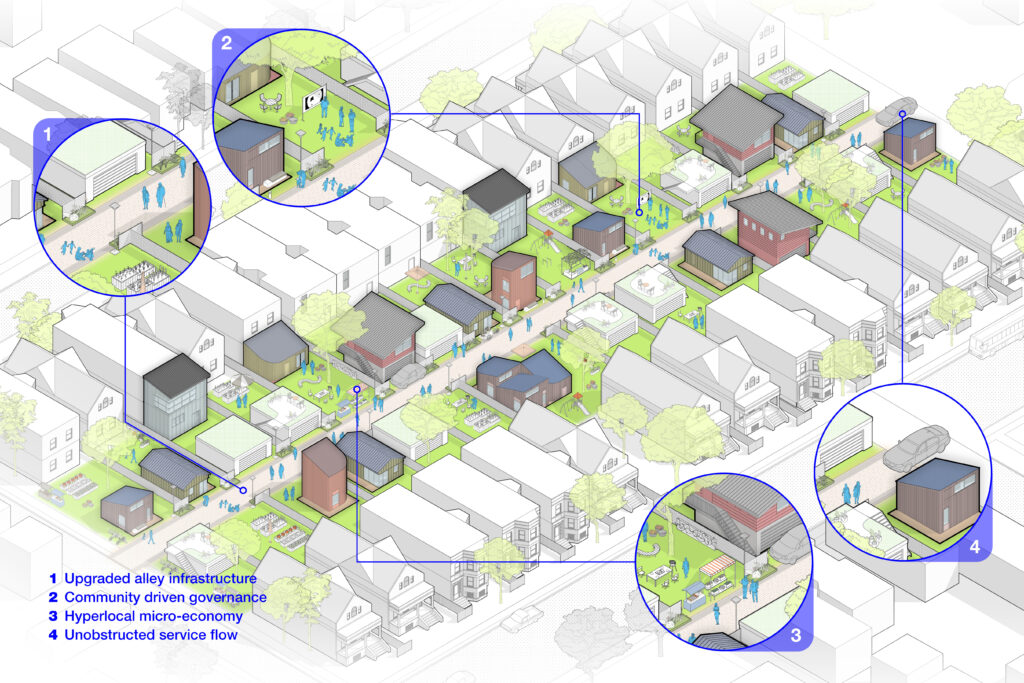
A third frontage has been hiding in plain sight for Chicago. By 2050, it has the potential to become an intricate civic layer of housing, nature, sustainability infrastructure, and bustling neighborhood life. This hidden layer stretches for approximately 1,900 miles and is one of the most distinctive urban networks in North America, if not the world. This third frontage is the alleyway network.
The network, as it currently stands, is anything but a frontage. Trash access, utilities, deliveries, vehicular passages, rear lot access…the alleyways have been dutifully serving their utilitarian purposes ever since James Thompson drew up Chicago’s first plat. The Third Frontage hereby asks a simple yet transformative question: What if this same network can serve as the basis for a new frontage typology that helps address Chicago’s housing, climate, equity, and neighborhood vitality? The initiative reimagines the alley, the backyard edge, and the rear lot as a new residential and civic landscape, one that can absorb growth, support daily life, and make Chicago more livable, resilient, and competitive over time.
By 2050, Chicago’s challenge will not be about whether it can grow. It will be about whether it can continue to grow in a way that is accessible, desirable, and economically viable to all people. World Business Chicago framed it clearly in their “Chicago 2050” report: the city must become “the easiest place in the U.S. to build and do business” while remaining “a great place to live and do business”. A Chicago that cannot add attainable living environments within its existing neighborhoods becomes harder to do business in, harder to build in, and harder to live in. Young workers leave. Older residents and longtime natives have narrower options. Families trade location for affordability. Businesses lose employees and the customers who sustain them. Downtown office-to-residential conversions and large redevelopment sites will certainly help, but they are not nearly enough compared to the broader scale of living conditions in the city. To meet the challenge of 2050 head-on, Chicago needs a repeatable model for neighborhood-scale growth: one that works within the ordinary residential block, one parcel at a time, without waiting for rare and expensive blank-slate opportunities. The Third Frontage aligns with this vision. It is a city-building strategy that helps Chicago attract, retain, and support residents over the long run.
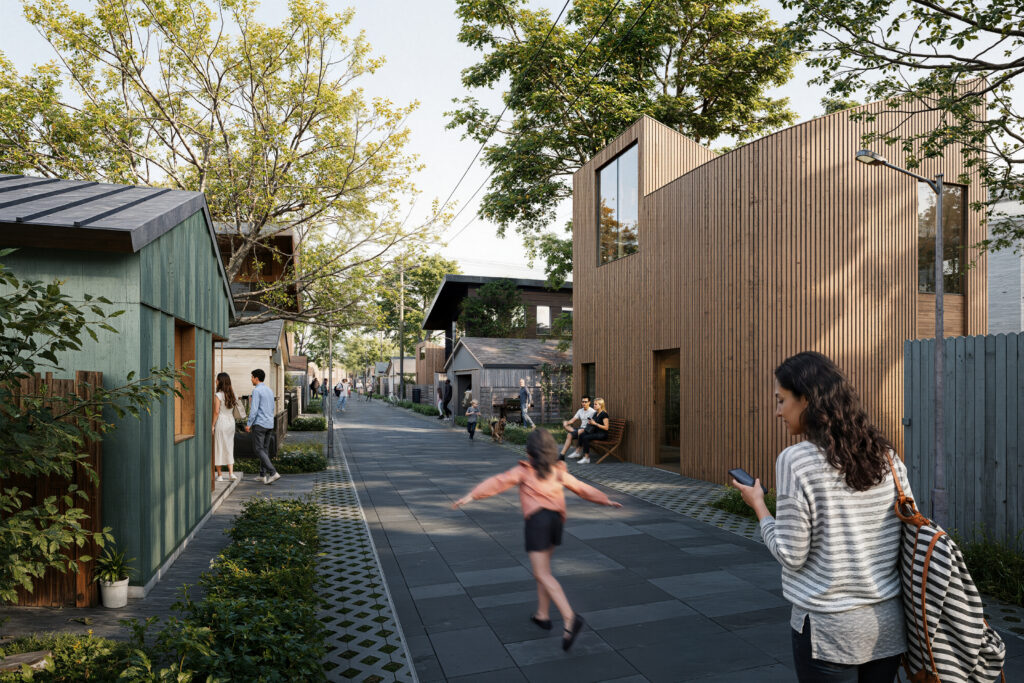
With The Third Frontage Initiative, first come with the alleyway upgrades. The alley itself will remain a working lane, but with a slight shift to its character. Service functions stay in the center, while the edges become permeable to allow for better stormwater capture. The edges will also enjoy more shades, as trees and planting are introduced to soften the hard surfaces. Rear lots, while almost exclusively devoted to garages and backyard storage as of today, begin to host a wider mix of programs and uses, such as compact additional dwelling units (ADUs), garage-to-housing conversions, coach-house-like additions, shared courts, community gardens…anything that turns the alley from a backdoor to an address. Light posts, porches, stoops, benches, bike storage, hyperlocal marketplaces, and alley-facing entries enhance the social conditions of a real, organic residential environment. Parking will be retained where car dependence is real, and reduced when the tradeoff supports better housing and public space. Over time, the evolution of the alley works in tandem with new rear-lot programs, culminating in a brand new Third Frontage that acts, literally and figuratively, as the backbone of the block’s social life.
It is important to note that the Initiative will not and cannot arrive through a one-size-fits-all rollout. It would begin by identifying pilot blocks in alley-served, low-rise, residential-focused neighborhoods where local buy-ins are strong. This process requires a coalition of all voices and an understanding deeply rooted in social equity. Constant community engagement and clear guidance from the city will help identify viable testbeds. The governance and maintenance of the alleyway is decided by the coalition. Everyone living on the block is empowered by a block-specific The Third Frontage Compact, a voluntary agreement among participating property owners, supported by city standards and neighborhood-based nonprofits, land trusts, or community development groups. This compact would set out clear, tangible public expectations on affordability and anti-displacement outcomes. It defines responsibilities for shared infrastructure such as lighting, drainage, and planting. It can also serve as technical guidance for small builders, community organizations, and nonprofit partners. In its essence, The Third Frontage reaches the corners where it’s needed through local trust, clear rules, and sustained community partnerships.
Eyeing forward, the path for The Third Frontage is already visible in Chicago’s policy landscape. The city has started reducing friction around housing production through Cut the Tape. It is testing small-scale infill through the Missing Middle Infill Housing initiative. Green Social Housing is establishing a strong link between affordability, sustainability, and mission-driven ownership. An ordinance aimed at doubling the number of parcels eligible for establishing additional dwelling units (ADUs) has just come into effect. There is real momentum in the city to elevate the living environments, and The Third Frontage will be the framework that delivers such momentum to the broader, alley-served blocks. With support from DPD, CDOT, CMAP, neighborhood nonprofits like Chicago Housing Trust, Neighborhood Housing Service (NHS) Chicago, and of course, individual property owners, the first decade of The Third Frontage can evolve quickly from pilots to proofs, demonstrating what a refreshed alleyway condition can bring to the table.
The Third Frontage Initiative is unmistakably Chicago, a city that has never depended solely on a single urban gesture to define its future, but rather has grown by layers and carried out long-running plans. Renewed streets and boulevards, two-flats and courtyard buildings, riverfronts, lakefronts, elevated trail lines…these are neighborhoods shaped through repeated acts of additions, adaptation, and strong civic ambition. The Third Frontage belongs to that tradition. By 2050, a child could be biking down a calmer alleyway under the canopy of a newly sprouted tree, passing a home of a caregiver where a garage used to be. Bioswales catch water after a summer storm, just in time for a neighborhood cookout in one of the shared community gardens…Not “one more frontage”, but a third frontage.
Block by block, alley through alley, the next great civic project of Chicago is hiding in plain sight.