
Chicago’s Advantage
NEWS
WBC Research Center
05.05.2026
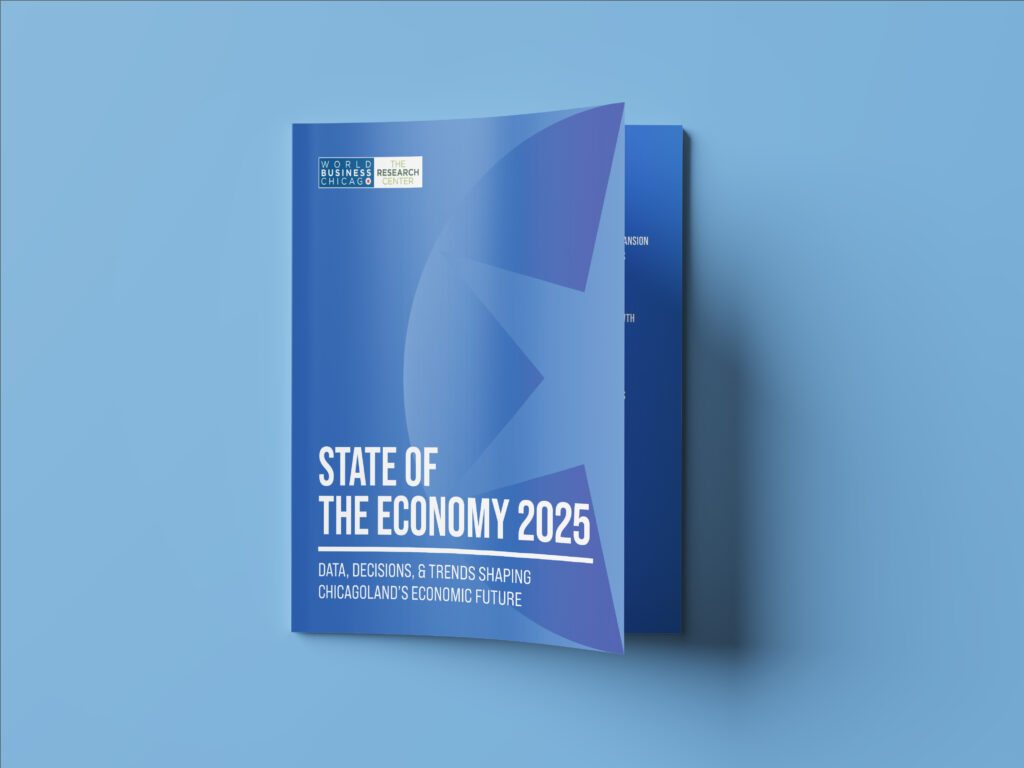
Throughout 2025, the Chicago metro area demonstrated the strength of its economic diversity, adaptability, and resilience, achieving record-breaking milestones in business relocations & expansion, and trade. At the same time, national forces — including tariffs, federal spending cuts, the rise of artificial intelligence, and an increasingly uneven economy — introduced uncertainty. Despite headwinds, the data show that the region’s underlying resilience and ability to adapt continued to drive performance. Chicagoland is the heart of the nation, geographically and metaphorically – our region’s performance represents the nation’s competitive edge.
Key Trends
The Chicago metro maintains dominance as the third-largest U.S. metro economy: Real growth of ~1.8% from a diverse industry base reflects steady expansion despite sharp federal policy shifts.
2025 was a record breaking year for business relocations and expansions: 223 Pro-Chicagoland Decisions—new, expanded, or relocated companies—added an estimated 19,600 jobs and $1.7B in earnings. The Chicago metro retains its crown as the nation’s leader for corporate relocations and expansions for the 13th year running.
The Chicago metro’s labor force remains near its highest level in recent memory: The Chicago metro’s labor force totals nearly 5 million, with a 66% participation rate and 4.5% unemployment. Growth was supported by rising immigration flows, though recent policy changes have slowed the trajectory.
The local job market is resilient amidst national cooling: Although the national job market remains cool compared to 2021 and 2022, job postings rose to 973,000 (+5.7% vs. 2024), with strongest demand in healthcare, logistics, sales, home health, and technology.
Strong local talent pipelines are adapting to changing labor market demand: Higher-education pipelines continue to expand, producing over 150,000 program completions annually, with emphasis on STEM, skilled trades, and healthcare.
WBC’s strategic industry focus addresses changing market dynamics: WBC’s Chicago 2050 targets sectors with regional scale and global advantage—including manufacturing, logistics, finance, life sciences, digital tech, AI, and emerging industries like clean energy and quantum—positioning the metro for long-term growth. Job gains in 2025 were led by healthcare, education, government, and construction; macro shifts were visible in job growth in professional services, manufacturing, and trade.
Chicago metro startups continue to access capital locally and globally for growth: Chicago-area companies raised over $6 billion across 574 deals, reflecting a shift toward fewer, larger, later-stage investments, concentrated in AI, software, and other productivity-enhancing sectors.
O’Hare leads the nation: Despite 2025 tariff shifts and changing trade patterns, Illinois remained a major trade hub and O’Hare became the nation’s top U.S. port by trade value ($423 billion).
Demand for Chicagoland housing pressures cost: Chicago metro retains a cost advantage compared with peer metros. Overall inflation has moderated compared to peers; however, growth in housing costs continue to pressure affordability. Leaders in the Chicago metro and Illinois are responding to this trend, aiming to make it easier to build in the region.
Growth Implications
The right mix of economic assets continue to attract and retain companies: Chicagoland’s #1 ranking for corporate relocations and expansions for 13 years in a row is not simply a trophy. It reflects a regional ecosystem that consistently converts competitive advantages into real investment decisions.
Workforce strategies must continue to adapt for future industries: Immigration policy changes have slowed labor force growth, and entry-level hiring remains subdued – both national trends playing out in the region. Continuing to invest in certificate programs, skilled trades, and worker transitions out of contracting industries—while aligning training with today’s technologies—will be critical for maintaining growth.
Early-stage business ecosystems need reinforcement: Growth capital is increasingly concentrated in later-stage deals, following national trends. Continuing to support early-stage funding is key to positioning Chicagoland as a center for innovation.
Trade infrastructure is a strategic asset: As tariff regimes reshaped supply chains, the region’s logistics infrastructure continues to prove its value. Continued investment in transportation connectivity and the workforce behind it is essential, as well as promotion of our incredible assets.
Inclusive growth must remain central: Chicago’s South and West Side neighborhoods accounted for roughly 5% of Pro-Chicagoland Decisions: a reminder that broader participation strengthens the entire regional economy.
Housing affordability is critical for economic competitiveness: Home prices rose faster in the Chicago metro than in any other major metro in 2025, and the region’s long-standing cost advantage is narrowing. Expanding housing supply through streamlined permitting, creating an easier building environment, and incentives for residential construction is essential.

Chicago 2050
Chicago’s Advantage
NEWS
02.26.2026
Hundreds of millions of people around the world celebrate Lunar New Year — observed across China, Vietnam, South Korea, Singapore, Malaysia, Indonesia, the Philippines, Thailand, Mongolia, and beyon

Chicago’s Advantage
Industries & Innovation
NEWS
02.26.2026
Data centers have emerged as one of the most consequential infrastructure investments of the twenty-first century. The global data center market was estimated at approximately $387 billion in 2025, wi

Chicago 2050
Chicago’s Advantage
Industries & Innovation
NEWS
WBC Research Center
02.26.2026
Chicagoland’s economy is in a moment of profound transformation — and our greatest advantage in navigating it is our workforce. As outlined in Chicago 2050 | A Plan for Economic…

Chicago 2050
Chicago’s Advantage
NEWS
05.04.2026
Chicago has always been a city that creates. A city that originates. A city whose ideas, culture, architecture, and innovations don’t just shape neighborhoods — they shape the world. From…