Bank of America Chicago Marathon: By the Numbers | World Business Chicago

Blogs

Chicago’s Advantage

WBC Blogs

WBC Research Center

10.09.2025

Bank of America Chicago Marathon: By the Numbers

Bank of America Chicago Marathon: By the Numbers

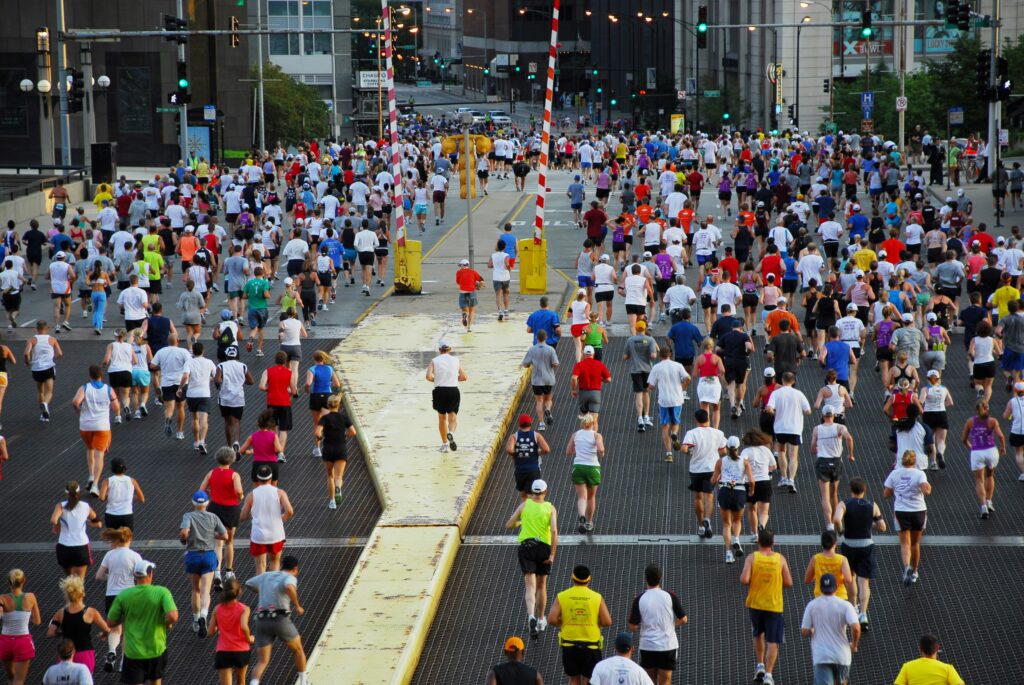
This Sunday marks the 47th annual Bank of America Chicago Marathon, where approximately 53,000 runners representing over 120 countries and all 50 states will be participating amidst the cheers of over a million spectators. Of the runners participating, 18,000 will be running for a charitable cause. This year’s course will take runners through nearly 30 vibrant and culturally unique neighborhoods, including but not limited to Chinatown, Bronzeville, Pilsen and Northalsted. 

The Chicago Marathon is an economic driver for the city.

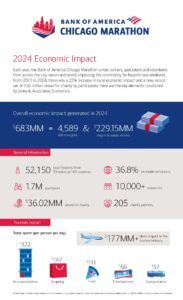
According to an independent study by Bank of America, lead sponsor for the race, the race’s total economic impact in 2024 was $683 million, a 22% increase from 2023. This included the creation of 4,589 full time jobs and $229.15 million in wages and salary income–not to mention, a new record of $36 million was raised for charity. This year’s race is expected to exceed last year’s economic impact. 
 

Beyond the race:

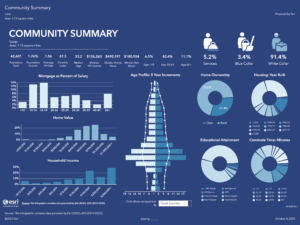
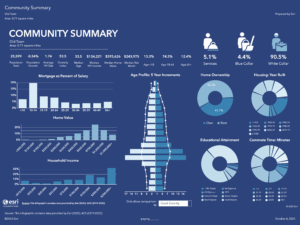
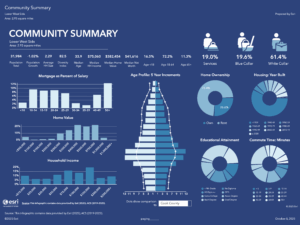
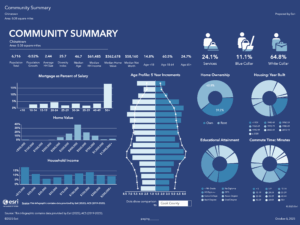
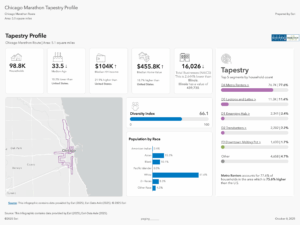
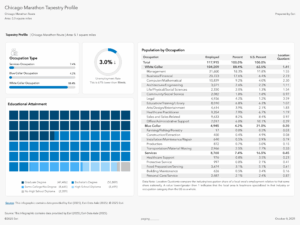
World Business Chicago analysis shows that within a block or so radius of the race route, there are over 16,000 businesses and 98,800 households. The median home value is $455,800 while the median household income is $104,000. Of the population by occupation, 88.4% of people were in white collar jobs, predominantly in management, business/finance or computer/mathematical roles. Unemployment in the area is 3% and over 100,000 have a graduate or bachelor’s degree.
 

Chicago’s has several vibrant neighborhoods and cultural assets along the route

Chicagoland, renowned for its history, architecture, food and music, is quite the site for sore eyes! With more than a fifth of the residents of foreign-born descent, and over 80 consulate generals—it’s a hub for cultural diversity as well. While on their journey past the finish line, runners will get to bask in some of Chicago’s more iconic historical and cultural sites! Let’s take a look at a few of the sites and neighborhoods they’ll be cruising by:

Chicago Board of Trade Building  — The Loop (Learn More)

  • Prior to being replaced by the current Board of Trade Building completed in 1930, the initial Board of Trade headquarters was constructed in 1885 and was the tallest building in Chicago at the time
  • The building was designed during the peak of the Art Deco styling
  • It is home to the world’s oldest futures and options exchange and there were a few periods both post construction in 1930 and later subsequent expansions that it was home to the world’s largest trading floor
  • The Board of Trade is a symbolic building for the city’s storied finance and insurance history. Read more about the region’s industry here.


Willis Tower — The Loop (Learn More)

  • At 110 stories tall, when completed in 1973, it was the tallest building in the world at that time, retaining that title for more than two decades
  • The building’s design was inspired by a staggered rows of packaged cigarettes 
  • It was initially built as the headquarters for Sears, Roebuck & Company
  • On clear days, four states can be seen—Illinois, Indiana, Wisconsin and Michigan; visibility from the infamous Skydeck on the 103rd floor is 40-50 miles


Second City — Old Town (Learn More)

  • Renowned improv comedic theater that opened in 1959 to foster homegrown comedic talent
  • Established by members of The Compass Players which is considered the first modern improvisational comedy troupe in America
  • The name was inspired by a term coined by a journalist with The New Yorker who wrote an article in the 1950s criticizing Chicago’s entertainment scene relative to New York City 
  • It gained more notoriety in the mid-1970s when Chicago alumni, such as John Belushi and Bill Murray, became stars of the popular show, Saturday Night Live
  • Notable alumni include Bill Murray, Tina Fey, Joan Rivers and Keegan-Michael Key


Thalia Hall — Pilsen (Learn More)

  • A historic landmark and mixed-used music, retail and dining space located in the Pilsen neighborhood located on the city’s Southwest Side.
  • Built in 1892, it was modeled after the State Opera opera house in Prague, Czech Republic
  • The building is named, Thalia, after the Greek muse of comedy and poetry
  • It was built to serve as a community hall for meetings as well as musical and theatrical productions


Chinatown Square Plaza Chinatown (Learn More)

  • A two-story outdoor mall built in 1993 containing retail, restaurants, condos and other businesses in Chinatown, a hub for Chinese culture and community
  • There Pan Asian Cultural Center is a central point of the plaza with 12 bronze Chinese zodiac figures that also line the square
  • The 8-foot “Chinese in America” mosaic mural commemorates the history of Chinese immigrants in the US and contains 100,000 individually cut pieces of hand painted glass from China specifically designed for the mural


Related News

Blogs

WBC Research Center

10.19.2025

New Research Report Reveals $11.8B Food Manufacturing Powerhouse Behind Chicago’s Innovation Economy

The Chicago Venture Summit: Future of Food 2025 delivered one of its strongest showings yet, marking the tenth edition of World Business Chicago’s signature innovation and investment platform. Since

View article

Blogs

Chicago’s Advantage

WBC Research Center

09.19.2025

Public Transit: The Backbone of Chicagoland’s Economy

Public transit isn’t just about trains and buses getting people from point A to point B. It’s about the daily life of our city and region: connecting workers to jobs,…

View article
Translate »