
Green City Rising
Horizon Lines Finalist
By The Morton Arboretum
Jill Koski, President & CEO, Morton Arboretum
Murphy Westwood, Vice President of Science and Conservation, provides overall scientific leadership and ensures alignment with best practices in biodiversity conservation, climate resilience, and applied research.
Zach Wirtz, Director, Chicago Region Trees Initiative (CRTI), leads regional coordination, municipal partnerships, and implementation strategies to expand equitable tree canopy across communities.
Andrea Brennan, ArbNet Manager, brings expertise in arboretum standards, accreditation, and international best practices to inform the development of a networked, place-based model.
Interdisciplinary staff across The Morton Arboretum’s Science and Conservation, Urban Forestry, and Community Engagement teams contribute expertise in tree biology, landscape design, public programming, and partnership development.
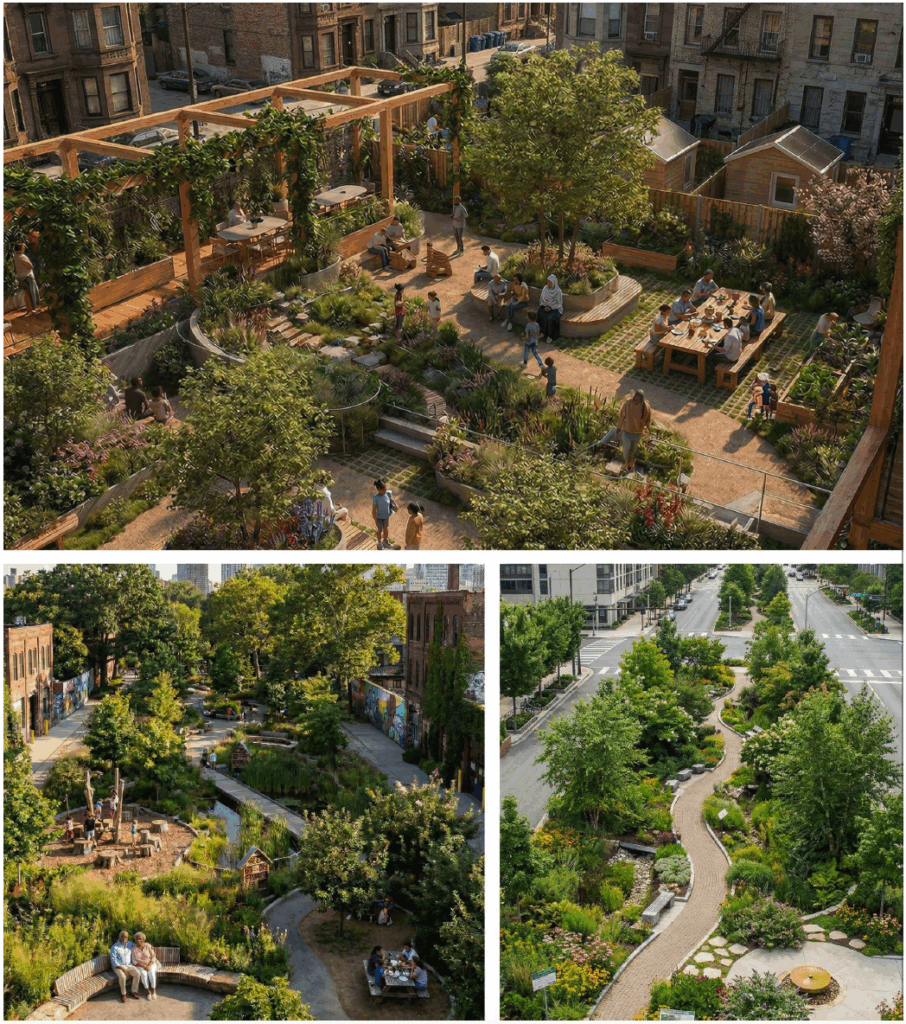
Green City Rising: Chicago’s Living Network of Neighborhood Arboreta
Building on Chicago’s historic identity as Urbs in Horto, a city in a garden,The Morton Arboretum advances Green City Rising, an ambitious, equity-centered initiative to establish a citywide network of neighborhood arboreta spanning Chicago’s communities. This coordinated system is designed to reflect the city’s cultural richness while rapidly expanding tree canopy and strengthening climate resilience, public health, and community vitality.
This is not simply a plan to plant more trees. Green City Rising positions urban forestry as essential civic infrastructure, a strategy transforming everyday spaces into interconnected, community-defined landscapes that address urgent urban challenges, including extreme heat, poor air quality, stormwater management, and inequitable access to green space. With Chicago projected to emerge as a climate haven by 2080, bringing both opportunity and population growth, the initiative ensures the city is prepared to grow in ways that are environmentally resilient and socially equitable.
Inspired by both Urbs in Horto and the Burnham Plan’s vision for a city designed around beauty, health, and civic life, Green City Rising reinterprets this legacy through a contemporary lens: community-driven, climate-responsive, and grounded in equity. Each neighborhood arboretum is shaped through participatory planning that centers local histories, cultural landscapes, and resident priorities, inviting communities to define what an arboretum can and should be in their neighborhood.
Core Idea and Why It Matters for Chicago’s Future
At its core, Green City Rising reimagines how nature lives within the city, and who shapes and stewards that presence. The initiative establishes a connected system of neighborhood-scale arboreta that function as both ecological infrastructure and civic assets.
Each site is designed to deliver layered benefits: expanding canopy, improving biodiversity, and integrating green infrastructure such as bioswales and rain gardens, while also creating spaces where residents gather, learn, and see their identities reflected in the landscape.
This approach is critical to Chicago’s future. As climate pressures intensify and population dynamics shift, the city’s long-term success will depend not only on environmental adaptation, but on investments that strengthen neighborhoods as places of stability, opportunity, and belonging. When designed in partnership with residents, green infrastructure can anchor community life, support local economies, and foster a strong sense of ownership.
The Problem and Opportunity
Chicago faces a dual challenge. Tree canopy coverage remains uneven across the city, with many neighborhoods, particularly on the South and West Sides, experiencing limited access to green space, higher temperatures, and greater exposure to environmental stressors. These disparities contribute directly to inequities in health, safety, and economic stability.
At the same time, Chicago stands at a pivotal moment of opportunity. As climate migration reshapes regional population patterns, the city is likely to attract new residents seeking stability and affordability. This growth will place increased demand on infrastructure and public space, while creating a rare opportunity to rethink how neighborhoods evolve.
Green City Rising addresses both realities by treating underutilized and fragmented spaces such as vacant lots, parkways, schoolyards, and corridors, as opportunities for transformation. Through coordinated investment and community-led design, these spaces become cohesive, welcoming landscapes that reduce environmental risk while strengthening neighborhood cohesion.
Shaping Chicago by 2050
By 2050, Green City Rising envisions a Chicago where every neighborhood is part of a visible, thriving green network, where tree canopy is not an amenity for some, but a shared civic resource.
A mature system of neighborhood arboreta will significantly expand canopy coverage, reduce urban heat islands, and improve stormwater management across the city. Just as importantly, it will redefine public space at the neighborhood scale. Residents will experience continuous, interconnected landscapes that support walking, gathering, and daily life: cooler streets, activated corridors, and recognizable community destinations.
These spaces will also function as platforms for workforce development, youth engagement, public safety, and community health, reinforcing long-term neighborhood stability and economic vitality. In doing so, Green City Rising positions Chicago as a national model for integrating climate adaptation with community-led placemaking.
Where and How the Idea Takes Shape
The vision is both citywide and deeply local, realized through a distributed set of neighborhood transformations that collectively form a connected system.
Neighborhood arboreta may take many forms: reimagined commercial corridors, enhanced school campuses, networks of revitalized vacant lots, strengthened park systems, or greened transportation corridors. Each site is shaped through participatory design, ensuring it reflects local culture, history, and priorities.
While each neighborhood arboretum will be distinct, all are unified by shared standards for ecological performance, community relevance, and long-term stewardship. Together, they form a cohesive, legible network that is visible across the city and embedded in daily life.
Implementation Pathway
Near-Term (0–5 years): Launch and Demonstrate
Initial efforts focus on establishing pilot sites across multiple neighborhoods, prioritizing areas with the greatest environmental and equity needs. This phase emphasizes co-design with residents, early implementation, and highly visible projects that demonstrate both environmental and social impact. Establishing a clear identity for the network through signage, storytelling, and programming will be critical in building public awareness and support.
Mid-Term (5–15 years): Expand and Connect
As early sites mature, the initiative expands to additional neighborhoods. Investments increasingly focus on connectivity, linking sites into corridors and systems that function at a larger scale. Integration with transportation, housing, and economic development initiatives ensures that green infrastructure reinforces broader neighborhood transformation goals.
Long-Term (15+ years): Sustain and Evolve
Over time, the network becomes a defining feature of Chicago’s urban fabric. Long-term stewardship models, stable funding streams, and ongoing community engagement will ensure that spaces remain vibrant and responsive. Continuous learning and adaptation allow the network to evolve alongside the city’s changing needs.
Key Stakeholders and Partnerships
Green City Rising is inherently collaborative. Implementation will be driven through partnerships with community-based organizations, civic groups and agencies, alongside regional alignment with initiatives such as Our Roots Chicago and forthcoming resilience frameworks from CMAP.
The Morton Arboretum serves as a scientific, technical, and convening partner, bringing deep expertise in urban forestry, canopy analysis, and long-term stewardship. A cornerstone of this work is the Arboretum’s Chicago Region Trees Initiative (CRTI), a nationally recognized model that advances tree planting, management, and equitable canopy expansion across the region. Through CRTI, the Arboretum works directly with municipalities, community organizations, and residents to plant and care for trees particularly in communities with the greatest canopy need, providing an established implementation framework that directly supports the goals of Green City Rising.
A second key institutional partner is ArbNet, the global arboretum accreditation network founded by The Morton Arboretum in collaboration with the American Public Gardens Association and Botanic Gardens Conservation International. ArbNet has accredited more than 1,000 arboreta worldwide, including dozens in the Chicago region, helping to formalize standards of excellence and connect local efforts to a global network.
Private sector and philanthropic partners play a critical role by supporting place-based investments within a unified citywide framework, offering scalable opportunities for funding, sponsorship, and innovation.
Enabling Tools: Policy, Planning, and Investment
Advancing Green City Rising will require coordinated policy, planning, and funding strategies. This includes integrating canopy goals into zoning and development guidelines, embedding green infrastructure into capital projects, and aligning investments across agencies.
A blended funding model combining public investment, philanthropy, and corporate support will be essential to scaling the initiative. The model’s emphasis on visible, community-centered transformation makes it particularly well suited for sponsorship and neighborhood-level investment strategies.
Why This Is Achievable in the Next 10 Years
Green City Rising is designed to move from vision to action quickly. It builds on existing momentum, including canopy initiatives, strong community relationships, and proven models of urban forestry and green infrastructure.
The Chicago Region Trees Initiative provides an immediate operational foundation, demonstrating the Arboretum’s ability to deliver large-scale, community-based tree planting and stewardship in partnership with local stakeholders. Just as importantly, Green City Rising aligns with broader trends in urban investment, particularly the growing emphasis on nature-based solutions, equitable development, and place-based philanthropy, leading to a more resilient urban forest while advancing equity, health, and opportunity for communities across Chicago.
Related Articles
Community Impact
Chicago is a city of neighborhoodsand we are investing in our local communities.INVEST South/West is leading this effort, providing investment where it is needed most, while World Business Chicago continues…
Read More
LaSalle Street Reimagined
The city of Chicago will subsidize renovations to the historic LaSalle Street corridor to introduce new apartments from converted office buildings. The Wall Street Journal reported on the City’s investment…
Read More
Chicago Business Bulletin: Logistics Tech in Chicago
In this updated version of Issue 3, the Research Center reports logistics tech is, “A fast-growing vertical within the TD&L industry capitalizing on Chicago’s historic strengths, evolving technology, and a…
Read More