
Chicago’s Advantage
10.07.2025
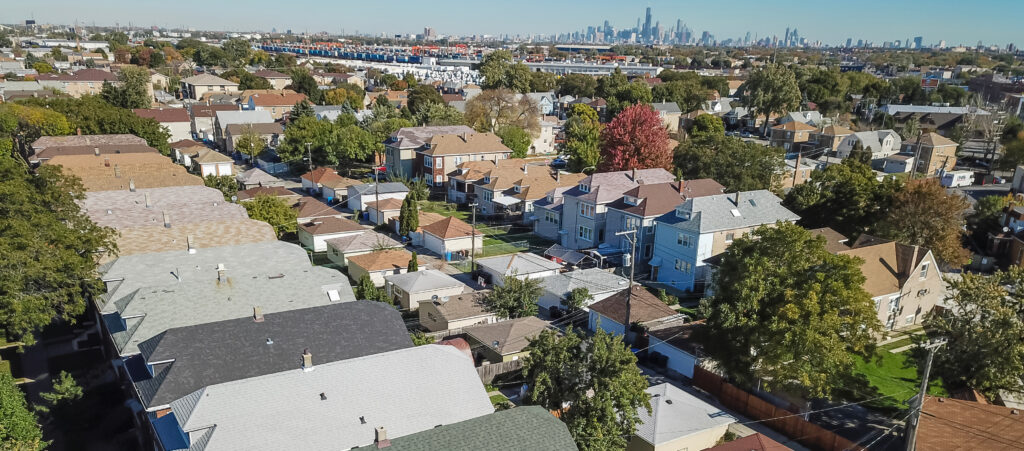
Cities thrive when working families, first-time buyers, and long-time residents can find homes they can afford. Yet in metro areas nationwide, the “missing middle” has quietly disappeared—These include the walk-ups, duplexes, and townhomes that sit between single-family houses and large apartment buildings.

Chicago is changing that equation. Under Mayor Brandon Johnson, a coordinated set of policies—developed through Build Better Together, an economic development program strengthening collaboration between key city departments—is being used to rebuild missing middle housing so Chicago’s 77 community areas can grow without pushing people out.
Missing-middle housing didn’t vanish by accident. Systemic public and private disinvestment over multiple decades eliminated the small multifamily buildings that once made blocks diverse, distinctive, and attainable.
The result: too many vacant lots and abandoned buildings in places that need investment—and too few options for teachers, nurses, first responders, and other middle-income households who want to plant roots in the city.
Under Build Better Together, a trio of innovative strategies managed by the Chicago Department of Housing and Chicago Department of Planning and Development are designed to bring the “missing middle” back:
Together, these tools are breaking through decades of disinvestment and positioning Chicago as a national model for middle-market housing that strengthens communities citywide.
The impact is direct and visible. Since its late-2023 launch, Cut the Tape has cut permitting timelines by more than 40%, removing friction that stalled small and mid-size builders. At the same time, updated zoning rules are clearing a path for multi-unit buildings scaled to fit well on residential streets.
The Missing Middle pilot is converting vacant city land into addresses that families can afford. The $40 million first phase, launched last fall, is transforming 40 empty lots in North Lawndale into 100+ new homes that range from two-flats to six-flats and are selling at market rate to draw working families back and stabilize the block. This summer, the City expanded the program with 54 additional lots across Chatham, South Chicago, and Morgan Park, selecting six minority-led development teams to deliver 108 homes with an expected value of $39 million, clustered in walk-up buildings scaled to complement their respective neighborhoods.
“Market-rate housing construction is essential to the City’s neighborhood repopulation and wealth-building goals, so we’re thrilled to advance hundreds of new housing types for buyers and renters,” Ciere Boatright, Commissioner of the Chicago Department of Planning and Development.

Scale and potential make this approach work. Two-, three-, and four-story buildings are right-sized for Chicago’s residential streets, and they create opportunities for both owners and renters. Buyers can purchase a 2- to 6-unit building, live in one unit, and rent the others—building intergenerational wealth while providing attainable housing for neighbors. That mix supports local businesses, keeps schools viable, and helps longtime residents stay rooted.
Middle-income families shouldn’t have to leave Chicago to find a home that fits their wants and needs. The City’s coordinated strategy—fast approvals, smart public financing, and neighborhood-scale homes—offers a pragmatic path to rebuild the housing ladder from the middle out. This is how we convert vacant land into value, translate policy into permits and projects, and make sure Chicago’s growth benefits people in every community area.
Bottom line, housing is about people. It’s the young family buying a first home in the city, the lifelong renter becoming an owner-landlord and building wealth for the next generation, and lights on in once-empty windows, new customers at neighborhood corner stores, and more stable blocks. Every new two-flat or six-flat is another place for a family to thrive—and another anchor for a stronger Chicago.
This is the third newsletter in our monthly Build Better Togetherseries, showcasing how collaboration across city departments is shaping a more vibrant, inclusive Chicago.
Stay tuned. Through Build Better Together, we’re shaping a Chicago where growth creates opportunity and possibility for every community

Chicago 2050
Chicago’s Advantage
NEWS
02.26.2026
Hundreds of millions of people around the world celebrate Lunar New Year — observed across China, Vietnam, South Korea, Singapore, Malaysia, Indonesia, the Philippines, Thailand, Mongolia, and beyon

Chicago’s Advantage
Industries & Innovation
NEWS
02.26.2026
Data centers have emerged as one of the most consequential infrastructure investments of the twenty-first century. The global data center market was estimated at approximately $387 billion in 2025, wi

Chicago 2050
Chicago’s Advantage
Industries & Innovation
NEWS
WBC Research Center
02.26.2026
Chicagoland’s economy is in a moment of profound transformation — and our greatest advantage in navigating it is our workforce. As outlined in Chicago 2050 | A Plan for Economic…

Chicago 2050
Chicago’s Advantage
NEWS
02.26.2026
Chicago has always been a city that creates. A city that originates. A city whose ideas, culture, architecture, and innovations don’t just shape neighborhoods — they shape the world. From…