
Chicago’s Advantage
Industries & Innovation
NEWS
12.17.2025
Across every major industry, robotics and intelligent automation are no longer emerging technologies—they are now defining competitive advantage, productivity, and the future of work. And nowhere is this transformation more aligned with regional priorities than in Chicagoland.
Robotics directly accelerates growth in the priority industries identified in the region’s new economic development playbook, Chicago 2050—including advanced manufacturing, food systems, transportation and logistics, healthcare, life sciences, and next-generation mobility.
With one of the nation’s most diversified economies, unparalleled logistics, world-class research institutions, and a rapidly expanding pipeline of robotics builders and adopters, Chicago is positioned to lead the next era of automation and industry innovation.
This week’s WBC Business Pulse, powered by LinkedIn explores the companies, technologies, and talent powering Chicago’s robotics ecosystem—and how these strengths support the goals outlined in Chicago 2050.

Throughout the world, robotics is shifting from a futuristic idea to utility. Even though the origins of manufacturing automation and robotics can be traced to the 15th and 16th centuries, the first industrial working robot prototype was created in 1930 using a Meccano model construction system. (reference: https://www.autodesk.com/design-make/articles/history-of-industrial-robots)
Fast forward to today, automation and robotics have advanced in capability and are integrated within industries beyond manufacturing. From logistics to food production, healthcare, and construction, companies are rapidly expanding their use of intelligent automation and preparing for humanoid robots working alongside humans (also referred to as cobots).
With the nation’s most diversified economy, a world-class R&D ecosystem, unmatched logistics infrastructure, and a growing network of robotics builders and adopters, Chicagoland is contributing to the evolution of intelligent automation and robotics in advanced manufacturing and pragmatic integration of humanoids within society.
According to Future Market Insights, the industrial robotics market is projected to increase from $55.1 billion in 2025 to $291.1 billion by 2035.
Manufacturing, food and beverage production, logistics, transportation, construction, and healthcare, our region’s largest sectors, are precisely the industries where robotics and humanoids are expected to scale fastest over the next decade.
The following factors are creating opportunities for companies seeking to grow in and in partnership within the Chicago region:
Robotics is not new to Chicago. Our region hosts companies throughout the automation, robotics, and humanoid ecosystem, from local established engineering and automation companies to multi-nationals and start-ups.

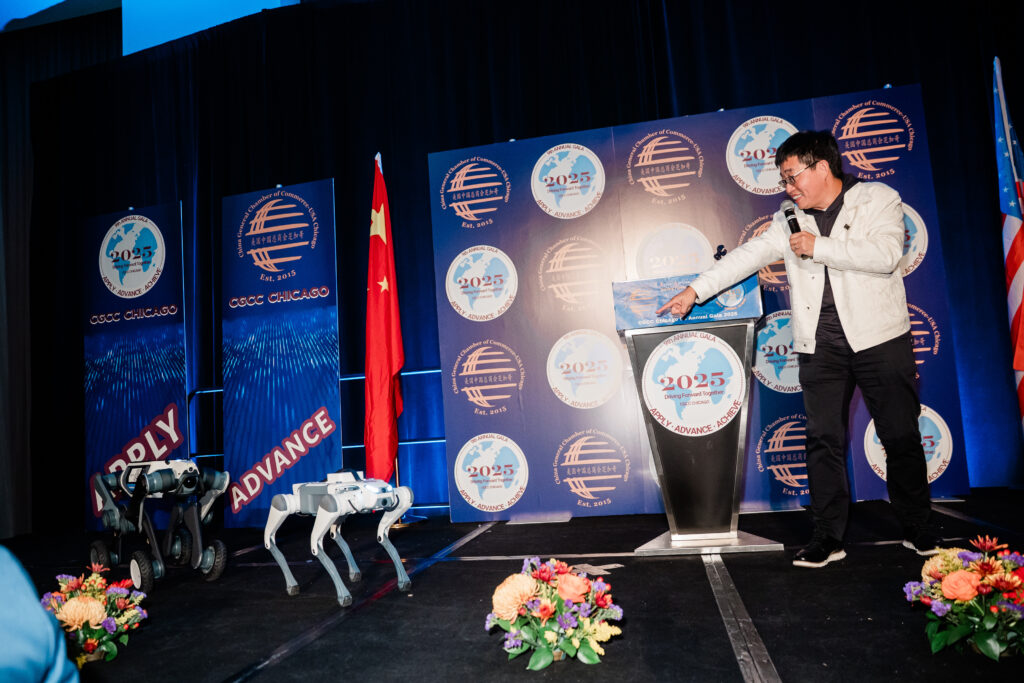
Earlier this year, World Business Chicago joined a Midwest delegation* to Hangzhou, where leaders met with some of the world’s most advanced robotics and humanoid companies. (Photo above; read more about that delegation here.) That momentum continued back in Chicago at the China General Chamber of Commerce Chicago (CGCC Chicago) 9th Annual Gala, where Deep Robotics’ AI robotic dog delivered a show-stopping performance, and IntBot’s humanoid robot greeted guests and demonstrated its capabilities live.
These engagements — from Hangzhou to downtown Chicago — are clear signals of the global interest in partnering with Chicago’s rapidly emerging robotics ecosystem.
As President of Wanxiang Group America Corporation — the U.S. arm of one of China’s largest industrial conglomerates and a long-standing investor across manufacturing, clean energy, and advanced mobility — Pin Ni has a unique vantage point on where the industry is heading.
“Chicago is uniquely positioned to lead the next wave of robotics and humanoid innovation,” said Pin Ni. “The city has what the future requires: a deep manufacturing base, strong customer demand, world-class universities, and a skilled workforce. The global advancements we’re seeing in robotics and components align perfectly with Chicago’s strengths. This is a market ready to scale, ready to attract world-class partners, and ready to define the future of this industry. Chicago has everything it needs not just to participate — but to lead.”
Chicago’s strength is not a single robotics mega-company or one marquee humanoid prototype. Our region’s strength is systems-level leadership—an ecosystem optimized for building, integrating, and scaling robotics in real industries with real-world complexity.
Chicago is where robotics moves from concept to prototype to industrial deployment to regional transformation and global impact.
Chicago-based Kadeya is transforming a traditionally linear, waste-heavy beverage supply chain into a fully circular system powered by robotics and smart automation. Its autonomous bottling stations sanitize, refill, and dispense reusable bottles on site, reducing costs while eliminating single-use plastics. The company shows how robotics can deliver practical, scalable sustainability in high-performance environments.
“Robotics allows Kadeya to rebuild value chains that were once inevitably linear,” said Manuela Zoninsein, Founder and CEO of Kadeya. “We use advanced automation to sterilize, fill, and dispense reusable bottles inside autonomous beverage kiosks, creating a circular system that eliminates single-use plastic with no change in user behavior and margin improvements unseen before. We’re showing that sustainability and efficiency can move forward together and that the future of beverage distribution can be completely waste-free. Robotics are a practical way to bring circularity and cost savings to environments where performance and uptime matter most.”
Below is a list of companies, innovators, and academic partners shaping the region’s robotics economy.
Robotics Companies & Innovators (in alphabetical order)
Academic & National Lab Partners (in alphabetical order)
Additional Reading
The rise of robotics and intelligent automation is not a distant vision—it is a powerful economic force reshaping the region’s most important industries. From advanced manufacturing to food systems, logistics, healthcare, and next-generation mobility, the very sectors prioritized in our economic plan for growth and jobs, Chicago 2050, are already deploying automation to scale, compete, and innovate.
Chicago’s robotics ecosystem reflects the strategy and ambition of Chicago 2050: a region built to translate ideas into deployment, and deployment into global advantage.
If your company is building automation technologies, integrating robotics, or exploring how these capabilities can accelerate growth, we want to hear from you.
Special thanks to World Business Chicago team for helping bring this week’s Business Pulse to life: Karla Ruth Orozco Toledano, Yiyun (Tanya) Tan, Rebecca Motley, Tony Kempa, Alex Iseri, Carla Agostinelli, Hannah Loftus.
If you’re interested in diving deeper into Chicago’s fast-growing robotics sector, we invite you to explore the companies and leaders highlighted above and here: BBS Automation Fluid Reality Formic HowToRobot mHUB Monarc Numina Group OMRON Americas Zenblen Zebra Technologies Argonne National Laboratory City Colleges of Chicago College of DuPage College of Lake County Joliet Junior College McHenry County College Northwestern University University of Illinois Urbana-Champaign Rivian
*Members of the Midwest delegation to Hangzhou included: Jeffrey Chamberlain, Steve Kim, Ansir Junaid, Matt Sacks, Max Budovitch, and Veerbhan K., Eric Greitens, Michael Fassnacht, Deputy Mayor Kenya K. Merritt, John McGuire Phil Clement Eric Branstad
Next week’s Business Pulse will highlight Mayor Brandon Johnson’s economic development platform, Build Better Together—with a focus on community safety, youth employment, homelessness and housing, and expanded mental health supports as core drivers of inclusive growth.

Chicago 2050
Chicago’s Advantage
NEWS
02.26.2026
Hundreds of millions of people around the world celebrate Lunar New Year — observed across China, Vietnam, South Korea, Singapore, Malaysia, Indonesia, the Philippines, Thailand, Mongolia, and beyon

Chicago’s Advantage
Industries & Innovation
NEWS
02.26.2026
Data centers have emerged as one of the most consequential infrastructure investments of the twenty-first century. The global data center market was estimated at approximately $387 billion in 2025, wi

Chicago 2050
Chicago’s Advantage
Industries & Innovation
NEWS
WBC Research Center
02.26.2026
Chicagoland’s economy is in a moment of profound transformation — and our greatest advantage in navigating it is our workforce. As outlined in Chicago 2050 | A Plan for Economic…

Chicago 2050
Chicago’s Advantage
NEWS
02.26.2026
Chicago has always been a city that creates. A city that originates. A city whose ideas, culture, architecture, and innovations don’t just shape neighborhoods — they shape the world. From…