

NEWS
WBC Research Center
07.22.2025
Chicago:Blend and The Research Center at World Business Chicago led by Robin Ficke recently published a report looking at startup founder diversity and funding (read the full report here). The collaborative report isn’t just a reflection of the gaps we know exist, but a roadmap as to how our continued focus on this will drive change.
Looking at VC raises by diverse founders in Chicago over the last five years we found:

“The report has sparked important dialogues, emphasizing the urgency of creating an ecosystem that empowers historically underrepresented founders,” said Robin Ficke, Senior Vice President,The Research Center at World Business Chicago. “The positive reception underscores the collective commitment to driving change and building a more inclusive future for Chicago’s tech industry.”
Under the guise of, “you can’t improve what you don’t measure,” we know that improving the equity of venture capital distribution across race, ethnicity and gender is a long game.
“What many people have focused on is the fact that although we have pretty good levels of representation across most demographic groups—usually coming in first or second relative to other cities included in the report—funding levels are a very different story, which underscores that much more work needs to be done to get more VC dollars in the hands of historically overlooked founders in Chicago and in most other cities,” said Joey Mak , CEO at Chicago:Blend.
In advance of the report publication, Robin and Joey sat down for a behind-the-scenes conversation. Watch the full interview on YouTube.
Key takeaways:
World Business Chicago is proud to have collaborated with Chicago:Blend because they are in the trenches and have a real-time view of progress and long game. Similarly, Chicago:Blend gained in accessing our strong research capabilities and team. “This creative approach to data storytelling is essential to us building a greater understanding of how opportunities to launch companies and raise funding need to be equitably across the ecosystem,” Joey Mak added.
Chicago 2050
Chicago’s Advantage
NEWS
02.26.2026
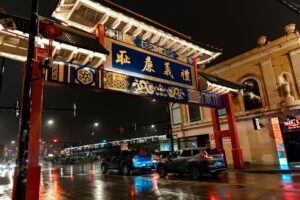
Hundreds of millions of people around the world celebrate Lunar New Year — observed across China, Vietnam, South Korea, Singapore, Malaysia, Indonesia, the Philippines, Thailand, Mongolia, and beyon

Chicago’s Advantage
Industries & Innovation
NEWS
02.26.2026
Data centers have emerged as one of the most consequential infrastructure investments of the twenty-first century. The global data center market was estimated at approximately $387 billion in 2025, wi

Chicago 2050
Chicago’s Advantage
Industries & Innovation
NEWS
WBC Research Center
02.26.2026
Chicagoland’s economy is in a moment of profound transformation — and our greatest advantage in navigating it is our workforce. As outlined in Chicago 2050 | A Plan for Economic…

Chicago 2050
Chicago’s Advantage
NEWS
02.26.2026
Chicago has always been a city that creates. A city that originates. A city whose ideas, culture, architecture, and innovations don’t just shape neighborhoods — they shape the world. From…